


Page 215 - Sedimentology and Stratigraphy
P. 215
202    Clastic Coasts and Estuaries


                                                              commonly form along coasts with a barrier system,
                                                              but can also be found along strand-plain coasts.
                                                                In a sedimentary succession these beach dune ridge
                                                              deposits may be seen as well-sorted sand at the top of
                                                              the beach succession (Fig. 13.6). Some preservation of
                                                              the roots of shrubs and trees that colonised the dune
                                                              field is possible, but the effect of the vegetation is often
                                                              to disrupt the preservation of well-developed dune
                                                              cross-bedding.


                                                              13.2.2 Coastal plains and strand plains

                                                              Coastal plains are low-lying areas adjacent to seas
                  Fig. 13.4 Foreshore-dipping and backshore-dipping strati-
                  fication in sands on a beach barrier bar.   (Fig. 13.7). They are part of the continental environ-
                                                              ment where there are fluvial, alluvial or aeolian pro-
                                                              cesses of sedimentation and pedogenic modification.
                  13.2.1 Beach dune ridges                    Coastal plains are influenced by the adjacent marine
                                                              environment when storm surges result in extensive
                  Aeolian processes can act on any loose sediment  flooding by seawater. A deposit related to storm flood-
                  exposed to the air. Along coasts any sand that dries  ing can be recognised by features such as the presence
                  out on the upper part of the beach is subject to rework-  of bioclastic debris of a marine fauna amongst depos-
                  ing by onshore winds that may redeposit it as aeolian  its that are otherwise wholly continental in character.
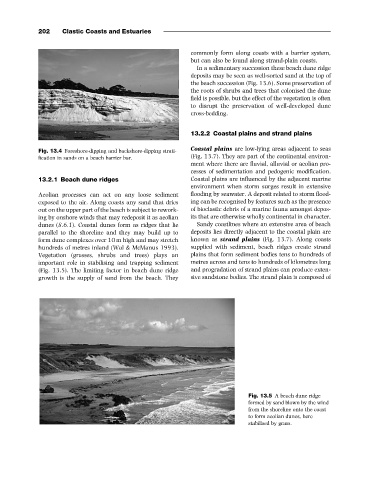
                  dunes (8.6.1). Coastal dunes form as ridges that lie  Sandy coastlines where an extensive area of beach
                  parallel to the shoreline and they may build up to  deposits lies directly adjacent to the coastal plain are
                  form dune complexes over 10 m high and may stretch  known as strand plains (Fig. 13.7). Along coasts
                  hundreds of metres inland (Wal & McManus 1993).  supplied with sediment, beach ridges create strand
                  Vegetation (grasses, shrubs and trees) plays an  plains that form sediment bodies tens to hundreds of
                  important role in stabilising and trapping sediment  metres across and tens to hundreds of kilometres long
                  (Fig. 13.5). The limiting factor in beach dune ridge  and progradation of strand plains can produce exten-
                  growth is the supply of sand from the beach. They  sive sandstone bodies. The strand plain is composed of


                                                                               Fig. 13.5 A beach dune ridge
                                                                               formed by sand blown by the wind
                                                                               from the shoreline onto the coast
                                                                               to form aeolian dunes, here
                                                                               stabilised by grass.

