


Page 218 - Sedimentology and Stratigraphy
P. 218
Barrier and Lagoon Systems   205


                                                              13.3.2 Lagoons
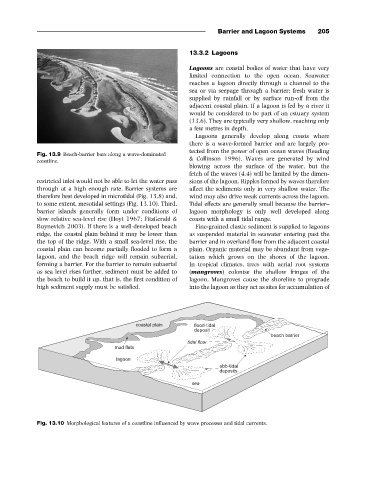
                                                              Lagoons are coastal bodies of water that have very
                                                              limited connection to the open ocean. Seawater
                                                              reaches a lagoon directly through a channel to the
                                                              sea or via seepage through a barrier; fresh water is
                                                              supplied by rainfall or by surface run-off from the
                                                              adjacent coastal plain. If a lagoon is fed by a river it
                                                              would be considered to be part of an estuary system
                                                              (13.6). They are typically very shallow, reaching only
                                                              a few metres in depth.
                                                               Lagoons generally develop along coasts where
                                                              there is a wave-formed barrier and are largely pro-
                                                              tected from the power of open ocean waves (Reading
                 Fig. 13.9 Beach-barrier bars along a wave-dominated
                 coastline.                                   & Collinson 1996). Waves are generated by wind
                                                              blowing across the surface of the water, but the
                                                              fetch of the waves (4.4) will be limited by the dimen-
                 restricted inlet would not be able to let the water pass  sions of the lagoon. Ripples formed by waves therefore
                 through at a high enough rate. Barrier systems are  affect the sediments only in very shallow water. The
                 therefore best developed in microtidal (Fig. 13.8) and,  wind may also drive weak currents across the lagoon.
                 to some extent, mesotidal settings (Fig. 13.10). Third,  Tidal effects are generally small because the barrier–
                 barrier islands generally form under conditions of  lagoon morphology is only well developed along
                 slow relative sea-level rise (Hoyt 1967; FitzGerald &  coasts with a small tidal range.
                 Buynevich 2003). If there is a well-developed beach  Fine-grained clastic sediment is supplied to lagoons
                 ridge, the coastal plain behind it may be lower than  as suspended material in seawater entering past the
                 the top of the ridge. With a small sea-level rise, the  barrier and in overland flow from the adjacent coastal
                 coastal plain can become partially flooded to form a  plain. Organic material may be abundant from vege-
                 lagoon, and the beach ridge will remain subaerial,  tation which grows on the shores of the lagoon.
                 forming a barrier. For the barrier to remain subaerial  In tropical climates, trees with aerial root systems
                 as sea level rises further, sediment must be added to  (mangroves) colonise the shallow fringes of the
                 the beach to build it up, that is, the first condition of  lagoon. Mangroves cause the shoreline to prograde
                 high sediment supply must be satisfied.      into the lagoon as they act as sites for accumulation of


 #


                                                                         #


                 Fig. 13.10 Morphological features of a coastline influenced by wave processes and tidal currents.

