


Page 219 - Sedimentology and Stratigraphy
P. 219
206    Clastic Coasts and Estuaries


                  sediment and organic matter along the water’s edge.
                  In more temperate climates, saline-tolerant grasses,
                  shrubs and trees may play a similar role in trapping
                  sediment. Coarser sediment may enter the lagoon
                  when storms wash sediment over the barrier as
                  washover deposits, which are thin layers of sand
                  reworked by waves. Sand is also blown into the
                  water by onshore winds picking up material from
                  the dunes along the barrier.
                    An important characteristic of lagoons is their
                  water chemistry. Due to the limited connection to
                  open ocean, it is common for lagoon water to have
                  either higher or lower salinity than seawater. Low
                  salinity, brackish water (10.3) will be a feature of
                  lagoons in areas of high rainfall, local run-off of
                  fresh water from the coastal plain or small streams.
                  Mixing of the lagoon water with the seawater is
                  insufficient to maintain full salinity in these brackish
                  lagoons. In more arid settings the evaporation from
                  the surface of the lagoon may exceed the rate at
                  which seawater exchanges with the lagoon water
                  and the conditions become hypersaline (10.3), that
                  is, with salinities higher than that of seawater. If
                  salinities become very elevated, precipitation of
                  evaporite minerals will occur (3.2).
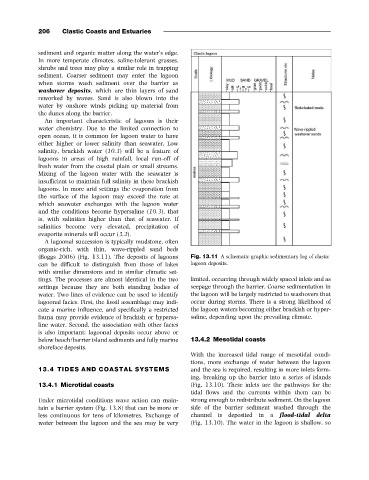
                    A lagoonal succession is typically mudstone, often
                  organic-rich, with thin, wave-rippled sand beds
                  (Boggs 2006) (Fig. 13.11). The deposits of lagoons  Fig. 13.11 A schematic graphic sedimentary log of clastic
                  can be difficult to distinguish from those of lakes  lagoon deposits.
                  with similar dimensions and in similar climatic set-
                  tings. The processes are almost identical in the two  limited, occurring through widely spaced inlets and as
                  settings because they are both standing bodies of  seepage through the barrier. Coarse sedimentation in
                  water. Two lines of evidence can be used to identify  the lagoon will be largely restricted to washovers that
                  lagoonal facies. First, the fossil assemblage may indi-  occur during storms. There is a strong likelihood of
                  cate a marine influence, and specifically a restricted  the lagoon waters becoming either brackish or hyper-
                  fauna may provide evidence of brackish or hypersa-  saline, depending upon the prevailing climate.
                  line water. Second, the association with other facies
                  is also important: lagoonal deposits occur above or
                  below beach/barrier island sediments and fully marine  13.4.2 Mesotidal coasts
                  shoreface deposits.
                                                              With the increased tidal range of mesotidal condi-
                                                              tions, more exchange of water between the lagoon
                  13.4 TIDES AND COASTAL SYSTEMS              and the sea is required, resulting in more inlets form-
                                                              ing, breaking up the barrier into a series of islands
                  13.4.1 Microtidal coasts                    (Fig. 13.10). These inlets are the pathways for the
                                                              tidal flows and the currents within them can be
                  Under microtidal conditions wave action can main-  strong enough to redistribute sediment. On the lagoon
                  tain a barrier system (Fig. 13.8) that can be more or  side of the barrier sediment washed through the
                  less continuous for tens of kilometres. Exchange of  channel  is  deposited  in  a  flood-tidal  delta
                  water between the lagoon and the sea may be very  (Fig. 13.10). The water in the lagoon is shallow, so

