


Page 214 - Sedimentology and Stratigraphy
P. 214
Beaches    201


                 13.2 BEACHES                                 of the foreshore, a back-beach gravel ridge that is a
                                                              distinctive feature of gravelly beaches. The clast com-
                 The beach is the area washed by waves breaking on  position will vary according to local sediment supply,
                 the coast. The seaward part of the beach is the  and may contain terrigenous clastic, volcaniclastic or
                 foreshore (11.1), which is a flat surface where  bioclastic debris.
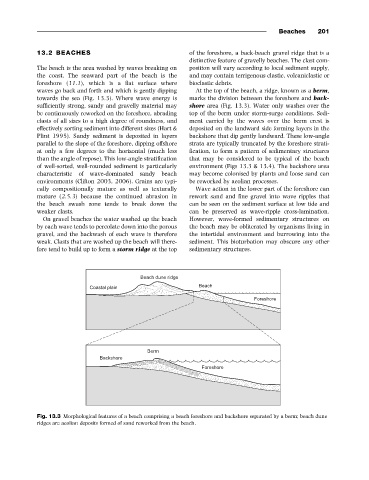
                 waves go back and forth and which is gently dipping  At the top of the beach, a ridge, known as a berm,
                 towards the sea (Fig. 13.3). Where wave energy is  marks the division between the foreshore and back-
                 sufficiently strong, sandy and gravelly material may  shore area (Fig. 13.3). Water only washes over the
                 be continuously reworked on the foreshore, abrading  top of the berm under storm-surge conditions. Sedi-
                 clasts of all sizes to a high degree of roundness, and  ment carried by the waves over the berm crest is
                 effectively sorting sediment into different sizes (Hart &  deposited on the landward side forming layers in the
                 Plint 1995). Sandy sediment is deposited in layers  backshore that dip gently landward. These low-angle
                 parallel to the slope of the foreshore, dipping offshore  strata are typically truncated by the foreshore strati-
                 at only a few degrees to the horizontal (much less  fication, to form a pattern of sedimentary structures
                 than the angle of repose). This low-angle stratification  that may be considered to be typical of the beach
                 of well-sorted, well-rounded sediment is particularly  environment (Figs 13.3 & 13.4). The backshore area
                 characteristic  of  wave-dominated  sandy  beach  may become colonised by plants and loose sand can
                 environments (Clifton 2003, 2006). Grains are typi-  be reworked by aeolian processes.
                 cally compositionally mature as well as texturally  Wave action in the lower part of the foreshore can
                 mature (2.5.3) because the continued abrasion in  rework sand and fine gravel into wave ripples that
                 the beach swash zone tends to break down the  can be seen on the sediment surface at low tide and
                 weaker clasts.                               can be preserved as wave-ripple cross-lamination.
                   On gravel beaches the water washed up the beach  However, wave-formed sedimentary structures on
                 by each wave tends to percolate down into the porous  the beach may be obliterated by organisms living in
                 gravel, and the backwash of each wave is therefore  the intertidal environment and burrowing into the
                 weak. Clasts that are washed up the beach will there-  sediment. This bioturbation may obscure any other
                 fore tend to build up to form a storm ridge at the top  sedimentary structures.


                 Fig. 13.3 Morphological features of a beach comprising a beach foreshore and backshore separated by a berm; beach dune
                 ridges are aeolian deposits formed of sand reworked from the beach.

