


Page 206 - Sedimentology and Stratigraphy
P. 206
Deltaic Cycles and Stratigraphy  193


                                                              the formation of mud drapes (11.2.4). Overbank areas
                                                              on the delta top may be partially tidal flats, and all of
                                                              the delta top will be susceptible to flooding during
                                                              periods of high fluvial discharge coupled with high
                                                              tides. The tidal currents rework sediments at the river
                                                              mouth into elongate bars that are perpendicular to the
                                                              shoreline. These are modified mouth bars, which may
                                                              show bidirectional cross-stratification and mud drapes
                                                              on the cross-bed foresets due to the reversing nature of
                                                              the ebb and flood tidal currents (Willis et al. 1999)
                                                              (11.2.4).
                                                               The deposits of a tidally influenced delta can be
                                                              distinguished from other deltas by the presence of
                                                              sedimentary structures and facies associations which
                                                              indicate that tidal processes were active (reversals of
                                                              palaeoflow, mud drapes, and so on), and subaqueous
                                                              mouth bars will be elongate parallel to the river
                                                              channels. The overall succession of strata will
                                                              display the characteristic coarsening-up of a delta
                                                              (Fig. 12.22), a feature that allows it to be distin-
                                                              guished from other tidally influenced environments
                                                              such as estuaries, which have much in common in
                                                              terms of depositional processes. The main distinguish-
                                                              ing feature is that a delta is always a progradational
                                                              feature, whereas an estuary commonly forms as
                                                              part of a retrogradational, or transgressive, succession
                                                              (23.1.6).


                                                              12.5  DELTAIC CYCLES AND
                                                              STRATIGRAPHY
                                                              When the channel on the delta top changes course,
                                                              the former lobe is abandoned as a new site of
                                                              deposition is occupied. River-dominated deltas tend
                                                              to have the most frequent changes in position of the
                                                              active lobe, but avulsion of channel course also
                                                              occurs in other delta types. The deposits of an aban-
                                                              doned lobe will gradually compact as water depos-
                                                              ited with the fine-grained sediment escapes from the
                                                              pore spaces and the bulk density increases. This
                                                              compaction occurs without any additional load,
                                                              and results in the abandoned lobe subsiding below
                                                              sea level. The fall below sea level of the abandoned
                                                              lobe will be accelerated if the delta is located in a
                                                              region of overall subsidence or if there is a eustatic
                                                              rise in sea level.
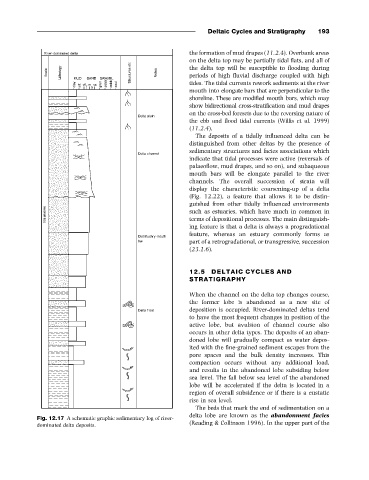
                                                               The beds that mark the end of sedimentation on a
                                                              delta lobe are known as the abandonment facies
                 Fig. 12.17 A schematic graphic sedimentary log of river-
                 dominated delta deposits.                    (Reading & Collinson 1996). In the upper part of the

