


Page 203 - Sedimentology and Stratigraphy
P. 203
190    Deltas


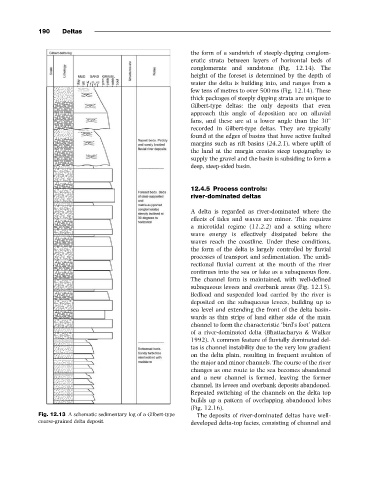
                                                              the form of a sandwich of steeply-dipping conglom-
                                                              eratic strata between layers of horizontal beds of
                                                              conglomerate and sandstone (Fig. 12.14). The
                                                              height of the foreset is determined by the depth of
                                                              water the delta is building into, and ranges from a
                                                              few tens of metres to over 500 ms (Fig. 12.14). These
                                                              thick packages of steeply dipping strata are unique to
                                                              Gilbert-type deltas: the only deposits that even
                                                              approach this angle of deposition are on alluvial
                                                              fans, and these are at a lower angle than the 308
                                                              recorded in Gilbert-type deltas. They are typically
                                                              found at the edges of basins that have active faulted
                                                              margins such as rift basins (24.2.1), where uplift of
                                                              the land at the margin creates steep topography to
                                                              supply the gravel and the basin is subsiding to form a
                                                              deep, steep-sided basin.


                                                              12.4.5 Process controls:
                                                              river-dominated deltas
                                                              A delta is regarded as river-dominated where the
                                                              effects of tides and waves are minor. This requires
                                                              a microtidal regime (11.2.2) and a setting where
                                                              wave energy is effectively dissipated before the
                                                              waves reach the coastline. Under these conditions,
                                                              the form of the delta is largely controlled by fluvial
                                                              processes of transport and sedimentation. The unidi-
                                                              rectional fluvial current at the mouth of the river
                                                              continues into the sea or lake as a subaqueous flow.
                                                              The channel form is maintained, with well-defined
                                                              subaqueous levees and overbank areas (Fig. 12.15).
                                                              Bedload and suspended load carried by the river is
                                                              deposited on the subaqueous levees, building up to
                                                              sea level and extending the front of the delta basin-
                                                              wards as thin strips of land either side of the main
                                                              channel to form the characteristic ‘bird’s foot’ pattern
                                                              of a river-dominated delta (Bhattacharya & Walker
                                                              1992). A common feature of fluvially dominated del-
                                                              tas is channel instability due to the very low gradient
                                                              on the delta plain, resulting in frequent avulsion of
                                                              the major and minor channels. The course of the river
                                                              changes as one route to the sea becomes abandoned
                                                              and a new channel is formed, leaving the former
                                                              channel, its levees and overbank deposits abandoned.
                                                              Repeated switching of the channels on the delta top
                                                              builds up a pattern of overlapping abandoned lobes
                                                              (Fig. 12.16).
                  Fig. 12.13 A schematic sedimentary log of a Gilbert-type  The deposits of river-dominated deltas have well-
                  coarse-grained delta deposit.               developed delta-top facies, consisting of channel and

