


Page 208 - Sedimentology and Stratigraphy
P. 208
Syndepositional Deformation in Deltas  195


                                                              a delta ‘cycle’ will be controlled by the depth of water
                                                              in the receiving basin (see above) and may range from
                                                              a few metres to tens or hundreds of metres in thick-
                                                              ness (Elliott 1986).
                                                               Variants on the idealised delta cycle are frequently
                                                              encountered (Fig. 12.23). A complete succession from
                                                              offshore fine-grained deposits up to the delta channel
                                                              fill will be seen only at the point where the axis of the
                                                              lobe has built out basinward. In other positions, the
                                                              top of the cycle will vary from delta-plain carbona-
                                                              ceous mudstones, to interdistributary bay deposits or
                                                              mouth-bar sands. In a hinterland direction, subsi-
                                                              dence will not be great enough for fully marine con-
                                                              ditions to develop at the base of each delta cycle, and
                                                              only the upper parts of the typical succession may be
                                                              seen (Elliott 1986).
                                                               In addition to the trends that represent the progra-
                                                              dation of delta lobes, smaller scale grain-size patterns
                                                              are also present. The filling of an interdistributary
                                                              bay results in a coarsening-up succession, but this
                                                              will normally be on a scale that is an order of magni-
                                                              tude smaller than the main delta cycle. Small-scale
                                                              fining-up trends are formed by the filling of distribu-
                                                              tary channels when they are abandoned.


                                                              12.6 SYNDEPOSITIONAL
                                                              DEFORMATIONINDELTAS

                                                              The delta front is a slope that can vary from about 18
                                                              in mud-rich settings to over 308 in coarse-grained
                                                              deltas. Even the very low angle slopes are potentially
                                                              unstable and mass movement of loose, soft sediment
                                                              on the delta slope is common. Debris flows, slumps
                                                              and slides (6.5.1) that consist of remobilised delta-
                                                              front deposits reworked and remobilised occur and
                                                              may be seen as part of the succession in deltaic facies.
                                                              The slumps and slides can be large-scale, involving
                                                              the movement of bodies of sediment tens of metres
                                                              thick and hundreds of metres across. The surfaces on
                                                              which the slides move are like faults, and these
                                                              features are often regarded as growth faults,
                                                              synsedimentary  deformation  structures  (18.1.1)
                                                              (Bhattacharya & Davies 2001). Further instabilities
                                                              also arise as a result of the relatively rapid accumula-
                                                              tion of sediment on a delta: coarser, and relatively
                                                              denser sediment of the delta top is built up on top of
                                                              muddy, wet and less dense delta-front facies and the
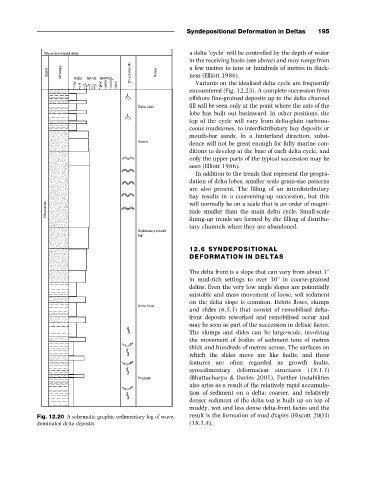
                 Fig. 12.20 A schematic graphic sedimentary log of wave-  result is the formation of mud diapirs (Hiscott 2003)
                 dominated delta deposits.                    (18.1.4).

