


Page 132 - Semiconductor Manufacturing Handbook
P. 132
Geng(SMH)_CH10.qxd  04/04/2005  19:46  Page 10.5


                                          ION IMPLANTATION AND RAPID THERMAL PROCESSING

                                                               ION IMPLANTATION AND RAPID THERMAL PROCESSING  10.5

                                  might help to neutralize that space charge are excluded from any region with finite electrostatic
                                  fields.
                                    The analyzer magnet in high-current tools typically bends the beam through approximately 90°
                                  with a radius of approximately 300 mm. The distance from the ion source to the entrance of the ana-
                                  lyzer magnet is typically no more than 200 to 300 mm, with a similar distance from the exit of the
                                  analyzer magnet to the resolving aperture. The distance from the resolving aperture to the wafer is
                                  in the range of 400 to 700 mm, producing a total beamline length in the range of 1.5 to 2 m.
                                    Emerging from the ion source and extraction optics, the beam is approximately 50 mm tall and
                                  converging slightly (in the nondispersive plane), and approximately 5 mm wide and diverging (in the
                                  dispersive plane). In the dispersive plane, the beam is focused by the analyzer magnet to a waist at
                                  the resolving aperture. The beam size passing through the resolving aperture is approximately 5 to
                                  25 mm, depending largely on the energy. The beam arrives at the wafer with a dispersive plant size
                                  in the range of 30 to 100 mm. In the nondispersive plane, there is typically much less focusing
                                  applied to the beam and the size of the beam is similar (approximately 50 mm) from the source to
                                  the wafer.
                                    Most ion implanters with the simple fixed-spot beamlines described previously also make use of
                                  multi-wafer process chamber geometries (see the following section) to improve overall tool produc-
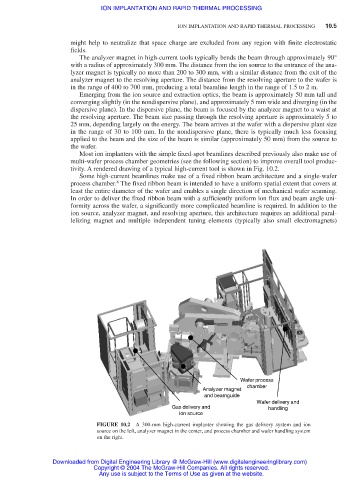
                                  tivity. A rendered drawing of a typical high-current tool is shown in Fig. 10.2.
                                    Some high-current beamlines make use of a fixed ribbon beam architecture and a single-wafer
                                              8
                                  process chamber. The fixed ribbon beam is intended to have a uniform spatial extent that covers at
                                  least the entire diameter of the wafer and enables a single direction of mechanical wafer scanning.
                                  In order to deliver the fixed ribbon beam with a sufficiently uniform ion flux and beam angle uni-
                                  formity across the wafer, a significantly more complicated beamline is required. In addition to the
                                  ion source, analyzer magnet, and resolving aperture, this architecture requires an additional paral-
                                  lelizing magnet and multiple independent tuning elements (typically also small electromagnets)


                                                                                Wafer process
                                                                                  chamber
                                                                      Analyzer magnet
                                                                      and beamguide
                                                                                    Wafer delivery and
                                                             Gas delivery and           handling
                                                               ion source
                                         FIGURE 10.2 A 300-mm high-current implanter showing the gas delivery system and ion
                                         source on the left, analyzer magnet in the center, and process chamber and wafer handling system
                                         on the right.


                             Downloaded from Digital Engineering Library @ McGraw-Hill (www.digitalengineeringlibrary.com)
                                        Copyright © 2004 The McGraw-Hill Companies. All rights reserved.
                                          Any use is subject to the Terms of Use as given at the website.

