


Page 136 - Semiconductor Manufacturing Handbook
P. 136
Geng(SMH)_CH10.qxd  04/04/2005  19:46  Page 10.9


                                          ION IMPLANTATION AND RAPID THERMAL PROCESSING

                                                               ION IMPLANTATION AND RAPID THERMAL PROCESSING  10.9

                                    Given that the beam is scanned in one dimension, mechanical wafer scanning of only one dimen-
                                  sion is required. For this reason, medium-current beamline architectures are almost exclusively cou-
                                  pled with single-wafer processing chambers.


                      10.3 ENDSTATION ARCHITECTURES

                      10.3.1 Multi-Wafer
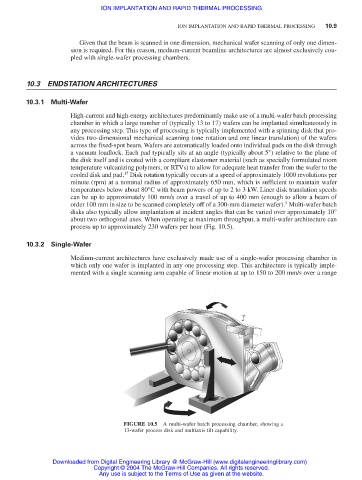
                                  High-current and high-energy architectures predominantly make use of a multi-wafer batch processing
                                  chamber in which a large number of (typically 13 to 17) wafers can be implanted simultaneously in
                                  any processing step. This type of processing is typically implemented with a spinning disk that pro-
                                  vides two-dimensional mechanical scanning (one rotation and one linear translation) of the wafers
                                  across the fixed-spot beam. Wafers are automatically loaded onto individual pads on the disk through
                                  a vacuum loadlock. Each pad typically sits at an angle (typically about 5°) relative to the plane of
                                  the disk itself and is coated with a compliant elastomer material (such as specially formulated room
                                  temperature vulcanizing polymers, or RTVs) to allow for adequate heat transfer from the wafer to the
                                                 17
                                  cooled disk and pad. Disk rotation typically occurs at a speed of approximately 1000 revolutions per
                                  minute (rpm) at a nominal radius of approximately 650 mm, which is sufficient to maintain wafer
                                  temperatures below about 80°C with beam powers of up to 2 to 3 kW. Liner disk translation speeds
                                  can be up to approximately 100 mm/s over a travel of up to 400 mm (enough to allow a beam of
                                                                                            5
                                  order 100 mm in size to be scanned completely off of a 300-mm diameter wafer). Multi-wafer batch
                                  disks also typically allow implantation at incident angles that can be varied over approximately 10°
                                  about two orthogonal axes. When operating at maximum throughput, a multi-wafer architecture can
                                  process up to approximately 230 wafers per hour (Fig. 10.5).

                      10.3.2 Single-Wafer
                                  Medium-current architectures have exclusively made use of a single-wafer processing chamber in
                                  which only one wafer is implanted in any one processing step. This architecture is typically imple-
                                  mented with a single scanning arm capable of linear motion at up to 150 to 200 mm/s over a range


                                                FIGURE 10.5  A multi-wafer batch processing chamber, showing a
                                                13-wafer process disk and multiaxis tilt capability.


                             Downloaded from Digital Engineering Library @ McGraw-Hill (www.digitalengineeringlibrary.com)
                                        Copyright © 2004 The McGraw-Hill Companies. All rights reserved.
                                          Any use is subject to the Terms of Use as given at the website.

