


Page 141 - Semiconductor Manufacturing Handbook
P. 141
Geng(SMH)_CH10.qxd  04/04/2005  19:46  Page 10.14


                                       ION IMPLANTATION AND RAPID THERMAL PROCESSING

                   10.14  WAFER PROCESSING

                               these “mass coincidences” include Mo ++  and BF (both have an apparent mass of 49 amu).
                                                                     2
                               Molybdenum is a common ion source arc chamber material that ionizes relatively easily; it is not
                               uncommon for this energetic contaminant to have levels as high as several tenths of a percent.
                               Manufacturers who rely on BF implants often turn to more expensive tungsten arc chambers specif-
                                                     2
                                                                                           +
                                                                                     +
                               ically to avoid this issue. Other common energetic contaminants include PF in BF (masses 50 and
                                                                                           2
                                                                              +
                               49, respectively) but are only present following long periods of P operation and can be easily miti-
                               gated with simple in situ plasma cleaning steps during process recipe transitions from one species to
                               another.
                   10.4.4 Wafer Charge Control
                               Delivering a large number of ions to the wafer can lead to very high electrostatic potentials if there
                                                                                            28
                               is not a sufficient supply of electrons to neutralize the positive charge as it arrives. Beam poten-
                               tials (and hence wafer potentials) of tens or even hundreds of volts would be commonplace with-
                               out such a supply of electrons. Of greatest concern in the face of such potentials is the integrity of
                               the dielectric gate oxide. Despite the fact that high-quality gate oxides can have breakdown fields
                               as high as 10 to 15 MV/cm, the gate oxides in modern devices are now no more than a few atoms
                               thick and are susceptible to breakdown with applied voltages of no more than a few volts. Luckily,
                               significant neutralization of these high potentials is achieved using electrons from a number of
                               sources. Secondary electrons generated by ion beam impact with the wafer itself and its support-
                               ing structures play a role in helping to control wafer charging. All modern high-current tools also
                               have active plasma sources in the vicinity of the wafer to provide an additional supply of electrons
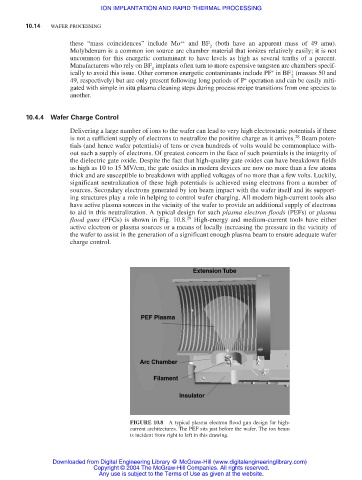
                               to aid in this neutralization. A typical design for such plasma electron floods (PEFs) or plasma
                               flood guns (PFGs) is shown in Fig. 10.8. 29  High-energy and medium-current tools have either
                               active electron or plasma sources or a means of locally increasing the pressure in the vicinity of
                               the wafer to assist in the generation of a significant enough plasma beam to ensure adequate wafer
                               charge control.


                                               FIGURE 10.8  A typical plasma electron flood gun design for high-
                                               current architectures. The PEF sits just before the wafer. The ion beam
                                               is incident from right to left in this drawing.


                          Downloaded from Digital Engineering Library @ McGraw-Hill (www.digitalengineeringlibrary.com)
                                     Copyright © 2004 The McGraw-Hill Companies. All rights reserved.
                                       Any use is subject to the Terms of Use as given at the website.

