


Page 145 - Semiconductor Manufacturing Handbook
P. 145
Geng(SMH)_CH11.qxd  04/04/2005  19:47  Page 11.2


                                                       WET ETCHING

                   11.2  WAFER PROCESSING


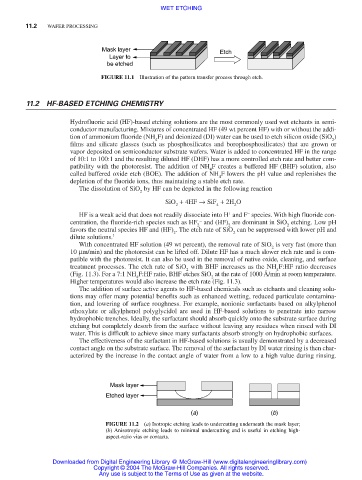
                                        Mask layer
                                                                        Etch
                                          Layer to
                                         be etched
                                       FIGURE 11.1  Illustration of the pattern transfer process through etch.


                   11.2 HF-BASED ETCHING CHEMISTRY

                               Hydrofluoric acid (HF)-based etching solutions are the most commonly used wet etchants in semi-
                               conductor manufacturing. Mixtures of concentrated HF (49 wt percent HF) with or without the addi-
                               tion of ammonium fluoride (NH F) and deionized (DI) water can be used to etch silicon oxide (SiO )
                                                      4                                               2
                               films and silicate glasses (such as phosphosilicates and borophosphosilicates) that are grown or
                               vapor deposited on semiconductor substrate wafers. Water is added to concentrated HF in the range
                               of 10:1 to 100:1 and the resulting diluted HF (DHF) has a more controlled etch rate and better com-
                               patibility with the photoresist. The addition of NH F creates a buffered HF (BHF) solution, also
                                                                     4
                               called buffered oxide etch (BOE). The addition of NH F lowers the pH value and replenishes the
                                                                       4
                               depletion of the fluoride ions, thus maintaining a stable etch rate.
                                 The dissolution of SiO by HF can be depicted in the following reaction
                                                  2
                                                         SiO + 4HF → SiF + 2H O
                                                            2          4   2
                                                                          +
                                                                               −
                                 HF is a weak acid that does not readily dissociate into H and F species. With high fluoride con-
                                                                  −
                               centration, the fluoride-rich species such as HF and (HF) are dominant in SiO etching. Low pH
                                                                 2        2               2
                               favors the neutral species HF and (HF) . The etch rate of SiO can be suppressed with lower pH and
                                                           2
                                                                           2
                               dilute solutions. 1
                                 With concentrated HF solution (49 wt percent), the removal rate of SiO is very fast (more than
                                                                                     2
                               10 µm/min) and the photoresist can be lifted off. Dilute HF has a much slower etch rate and is com-
                               patible with the photoresist. It can also be used in the removal of native oxide, cleaning, and surface
                               treatment processes. The etch rate of SiO with BHF increases as the NH F:HF ratio decreases
                                                              2                        4
                               (Fig. 11.3). For a 7:1 NH F:HF ratio, BHF etches SiO at the rate of 1000 Å/min at room temperature.
                                                 4                   2
                               Higher temperatures would also increase the etch rate (Fig. 11.3).
                                 The addition of surface active agents to HF-based chemicals such as etchants and cleaning solu-
                               tions may offer many potential benefits such as enhanced wetting, reduced particulate contamina-
                               tion, and lowering of surface roughness. For example, nonionic surfactants based on alkylphenol
                               ethoxylate or alkylphenol polyglycidol are used in HF-based solutions to penetrate into narrow
                               hydrophobic trenches. Ideally, the surfactant should absorb quickly onto the substrate surface during
                               etching but completely desorb from the surface without leaving any residues when rinsed with DI
                               water. This is difficult to achieve since many surfactants absorb strongly on hydrophobic surfaces.
                                 The effectiveness of the surfactant in HF-based solutions is usually demonstrated by a decreased
                               contact angle on the substrate surface. The removal of the surfactant by DI water rinsing is then char-
                               acterized by the increase in the contact angle of water from a low to a high value during rinsing.
                                          Mask layer
                                         Etched layer

                                                                (a)                  (b)
                                         FIGURE 11.2  (a) Isotropic etching leads to undercutting underneath the mask layer;
                                         (b) Anisotropic etching leads to minimal undercutting and is useful in etching high-
                                         aspect-ratio vias or contacts.


                          Downloaded from Digital Engineering Library @ McGraw-Hill (www.digitalengineeringlibrary.com)
                                     Copyright © 2004 The McGraw-Hill Companies. All rights reserved.
                                       Any use is subject to the Terms of Use as given at the website.

