


Page 147 - Semiconductor Manufacturing Handbook
P. 147
Geng(SMH)_CH11.qxd  04/04/2005  19:48  Page 11.4


                                                       WET ETCHING

                   11.4  WAFER PROCESSING

                                     0.030                            0.030
                                                                                              0 min
                                                            60 min
                                     0.025                  30 min    0.025                   1 min
                                                            20 min                            5 min
                                     0.020                  10 min    0.020                   10 min
                                    Absorbance  0.015       1 min   Absorbance  0.015         60 min
                                                                                              30 min
                                                            5 min
                                     0.010
                                                                      0.010
                                     0.005                            0.005
                                     0.000                            0.000
                                        3050 3000 2950 2900 2850 2800 2750  3050 3000 2950 2900 2850 2800 2750
                                               Wavenumber (cm −1 )              Wavenumber (cm −1 )
                                                    (a)                             (b)
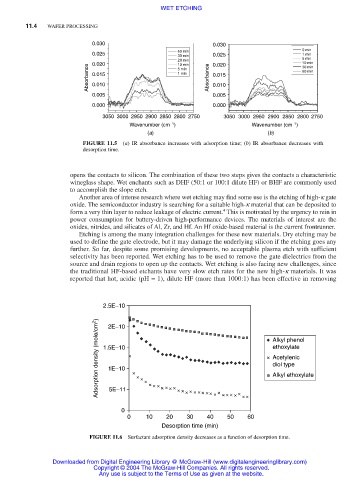
                                  FIGURE 11.5  (a) IR absorbance increases with adsorption time; (b) IR absorbance decreases with
                                  desorption time.


                               opens the contacts to silicon. The combination of these two steps gives the contacts a characteristic
                               wineglass shape. Wet enchants such as DHF (50:1 or 100:1 dilute HF) or BHF are commonly used
                               to accomplish the slope etch.
                                 Another area of intense research where wet etching may find some use is the etching of high-κ gate
                               oxide. The semiconductor industry is searching for a suitable high-κ material that can be deposited to
                               form a very thin layer to reduce leakage of electric current. This is motivated by the urgency to rein in
                                                                        4
                               power consumption for battery-driven high-performance devices.  The materials of interest are the
                               oxides, nitrides, and silicates of Al, Zr, and Hf. An Hf oxide-based material is the current frontrunner.
                                 Etching is among the many integration challenges for these new materials. Dry etching may be
                               used to define the gate electrode, but it may damage the underlying silicon if the etching goes any
                               further. So far, despite some promising developments, no acceptable plasma etch with sufficient
                               selectivity has been reported. Wet etching has to be used to remove the gate dielectrics from the
                               source and drain regions to open up the contacts. Wet etching is also facing new challenges, since
                               the traditional HF-based etchants have very slow etch rates for the new high-κ materials. It was
                               reported that hot, acidic (pH = 1), dilute HF (more than 1000:1) has been effective in removing


                                        2.5E−10
                                      Adsorption density (mole/cm 2 )  1.5E−10        Alkyl phenol
                                         2E−10

                                                                                      ethoxylate
                                                                                      Acetylenic
                                                                                      diol type
                                         1E−10
                                                                                      Alkyl ethoxylate

                                          5E−11

                                             0
                                              0     10   20    30   40   50    60
                                                        Desorption time (min)
                                    FIGURE 11.6  Surfactant adsorption density decreases as a function of desorption time.


                          Downloaded from Digital Engineering Library @ McGraw-Hill (www.digitalengineeringlibrary.com)
                                     Copyright © 2004 The McGraw-Hill Companies. All rights reserved.
                                       Any use is subject to the Terms of Use as given at the website.

