


Page 146 - Semiconductor Manufacturing Handbook
P. 146
Geng(SMH)_CH11.qxd  04/04/2005  19:48  Page 11.3


                                                          WET ETCHING

                                                                                           WET ETCHING  11.3

                                                     6000
                                                     5000
                                                    Etch rate (Å/min)  4000        5:1 BHF

                                                                                   7:1 BHF
                                                     3000
                                                                                   10:1 BHF
                                                     2000
                                                     1000
                                                        0
                                                         20       40        60
                                                             Temperature (°C)
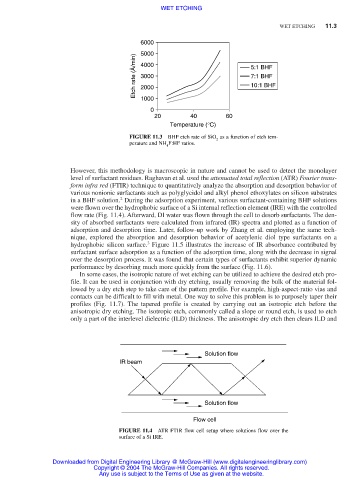
                                                  FIGURE 11.3  BHF etch rate of SiO as a function of etch tem-
                                                                         2
                                                  perature and NH F:HF ratios.
                                                            4

                                  However, this methodology is macroscopic in nature and cannot be used to detect the monolayer
                                  level of surfactant residues. Raghavan et al. used the attenuated total reflection (ATR) Fourier trans-
                                  form infra red (FTIR) technique to quantitatively analyze the absorption and desorption behavior of
                                  various nonionic surfactants such as polyglycidol and alkyl phenol ethoxylates on silicon substrates
                                                2
                                  in a BHF solution. During the adsorption experiment, various surfactant-containing BHF solutions
                                  were flown over the hydrophobic surface of a Si internal reflection element (IRE) with the controlled
                                  flow rate (Fig. 11.4). Afterward, DI water was flown through the cell to desorb surfactants. The den-
                                  sity of absorbed surfactants were calculated from infrared (IR) spectra and plotted as a function of
                                  adsorption and desorption time. Later, follow-up work by Zhang et al. employing the same tech-
                                  nique, explored the absorption and desorption behavior of acetylenic diol type surfactants on a
                                                       3
                                  hydrophobic silicon surface. Figure 11.5 illustrates the increase of IR absorbance contributed by
                                  surfactant surface adsorption as a function of the adsorption time, along with the decrease in signal
                                  over the desorption process. It was found that certain types of surfactants exhibit superior dynamic
                                  performance by desorbing much more quickly from the surface (Fig. 11.6).
                                    In some cases, the isotropic nature of wet etching can be utilized to achieve the desired etch pro-
                                  file. It can be used in conjunction with dry etching, usually removing the bulk of the material fol-
                                  lowed by a dry etch step to take care of the pattern profile. For example, high-aspect-ratio vias and
                                  contacts can be difficult to fill with metal. One way to solve this problem is to purposely taper their
                                  profiles (Fig. 11.7).  The tapered profile is created by carrying out an isotropic etch before the
                                  anisotropic dry etching. The isotropic etch, commonly called a slope or round etch, is used to etch
                                  only a part of the interlevel dielectric (ILD) thickness. The anisotropic dry etch then clears ILD and


                                                                      Solution flow
                                               IR beam


                                                                      Solution flow

                                                                   Flow cell
                                               FIGURE 11.4  ATR FTIR flow cell setup where solutions flow over the
                                               surface of a Si IRE.


                             Downloaded from Digital Engineering Library @ McGraw-Hill (www.digitalengineeringlibrary.com)
                                        Copyright © 2004 The McGraw-Hill Companies. All rights reserved.
                                          Any use is subject to the Terms of Use as given at the website.

