


Page 210 - Semiconductor Manufacturing Handbook
P. 210
Geng(SMH)_CH14.qxd  04/04/2005  19:52  Page 14.11


                                                    CHEMICAL VAPOR DEPOSITION

                                                                              CHEMICAL VAPOR DEPOSITION  14.11

                      14.3 COMPONENTS OF A CVD SYSTEM

                                  Up until now, our focus has been on a process chamber where reactions occur and films are deposited
                                  on silicon wafers. The chamber is a key component of a CVD system, but it is not the only one. Gases
                                  must be delivered to the chamber precisely and uniformly, then efficiently removed. RF energy must
                                  be coupled to the chamber. Wafers must be moved to the loadlock, pumped down, and then transferred
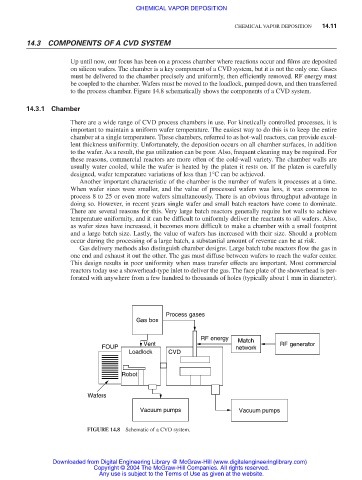
                                  to the process chamber. Figure 14.8 schematically shows the components of a CVD system.

                      14.3.1 Chamber
                                  There are a wide range of CVD process chambers in use. For kinetically controlled processes, it is
                                  important to maintain a uniform wafer temperature. The easiest way to do this is to keep the entire
                                  chamber at a single temperature. These chambers, referred to as hot-wall reactors, can provide excel-
                                  lent thickness uniformity. Unfortunately, the deposition occurs on all chamber surfaces, in addition
                                  to the wafer. As a result, the gas utilization can be poor. Also, frequent cleaning may be required. For
                                  these reasons, commercial reactors are more often of the cold-wall variety. The chamber walls are
                                  usually water cooled, while the wafer is heated by the platen it rests on. If the platen is carefully
                                  designed, wafer temperature variations of less than 1°C can be achieved.
                                    Another important characteristic of the chamber is the number of wafers it processes at a time.
                                  When wafer sizes were smaller, and the value of processed wafers was less, it was common to
                                  process 8 to 25 or even more wafers simultaneously. There is an obvious throughput advantage in
                                  doing so. However, in recent years single wafer and small batch reactors have come to dominate.
                                  There are several reasons for this. Very large batch reactors generally require hot walls to achieve
                                  temperature uniformity, and it can be difficult to uniformly deliver the reactants to all wafers. Also,
                                  as wafer sizes have increased, it becomes more difficult to make a chamber with a small footprint
                                  and a large batch size. Lastly, the value of wafers has increased with their size. Should a problem
                                  occur during the processing of a large batch, a substantial amount of revenue can be at risk.
                                    Gas delivery methods also distinguish chamber designs. Large batch tube reactors flow the gas in
                                  one end and exhaust it out the other. The gas must diffuse between wafers to reach the wafer center.
                                  This design results in poor uniformity when mass transfer effects are important. Most commercial
                                  reactors today use a showerhead-type inlet to deliver the gas. The face plate of the showerhead is per-
                                  forated with anywhere from a few hundred to thousands of holes (typically about 1 mm in diameter).


                                                            Process gases
                                                    Gas box

                                                                     RF energy  Match
                                                      Vent                                 RF generator
                                          FOUP                                 network
                                                  Loadlock  CVD

                                                Robot


                                       Wafers
                                                     Vacuum pumps               Vacuum pumps

                                       FIGURE 14.8  Schematic of a CVD system.


                             Downloaded from Digital Engineering Library @ McGraw-Hill (www.digitalengineeringlibrary.com)
                                        Copyright © 2004 The McGraw-Hill Companies. All rights reserved.
                                          Any use is subject to the Terms of Use as given at the website.

