


Page 208 - Semiconductor Manufacturing Handbook
P. 208
Geng(SMH)_CH14.qxd  04/04/2005  19:52  Page 14.9


                                                    CHEMICAL VAPOR DEPOSITION

                                                                               CHEMICAL VAPOR DEPOSITION  14.9

                      14.2.5 Particles
                                  Like any piece of semiconductor equipment, CVD systems can suffer from particle contamination.
                                  In addition to the typical sources, like flaking or friction, CVD systems can create particles from the
                                  chemistry itself. To get a handle on the particles, it is important to understand both how they are cre-
                                  ated and how they are transported to the wafer.

                                  Creation Mechanisms. Particles can be generated in a chamber volume through gas-phase reactions,
                                  or they can form at surfaces through flaking and abrasion. In addition, moisture droplets can nucle-
                                  ate on particles in the load lock during pumpdown. Of these mechanisms, only gas-phase nucleation
                                  (GPN) is unique to CVD. In the ideal CVD process, the gaseous precursors don’t react in the gas-
                                  phase, or do so very slowly. However, at high pressures—where there are many gas collisions—and
                                  high temperatures, many processes will proceed in the gas phase. The chemistry of GPN is complex
                                  and has only been studied in depth for silicon deposition. 10,11  Once created, particles can be trans-
                                  ported to the wafer surface, resulting in a defect.

                                  Transport Mechanisms.  There are five mechanisms for transporting particles in CVD reactors.
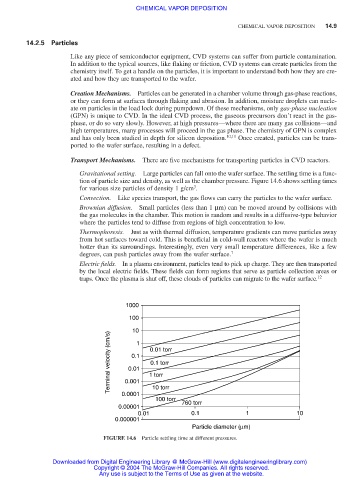
                                    Gravitational setting.  Large particles can fall onto the wafer surface. The settling time is a func-
                                    tion of particle size and density, as well as the chamber pressure. Figure 14.6 shows settling times
                                                                   3
                                    for various size particles of density 1 g/cm .
                                    Convection.  Like species transport, the gas flows can carry the particles to the wafer surface.
                                    Brownian diffusion.  Small particles (less than 1 µm) can be moved around by collisions with
                                    the gas molecules in the chamber. This motion is random and results in a diffusive-type behavior
                                    where the particles tend to diffuse from regions of high concentration to low.
                                    Thermophoresis.  Just as with thermal diffusion, temperature gradients can move particles away
                                    from hot surfaces toward cold. This is beneficial in cold-wall reactors where the wafer is much
                                    hotter than its surroundings. Interestingly, even very small temperature differences, like a few
                                    degrees, can push particles away from the wafer surface. 7
                                    Electric fields. In a plasma environment, particles tend to pick up charge. They are then transported
                                    by the local electric fields. These fields can form regions that serve as particle collection areas or
                                    traps. Once the plasma is shut off, these clouds of particles can migrate to the wafer surface. 12


                                                 1000

                                                  100
                                                   10 1
                                             Terminal velocity (cm/s)  0.01  1 torr
                                                       0.01 torr
                                                   0.1
                                                        0.1 torr

                                                 0.001
                                                        10 torr
                                                0.0001
                                                         100 torr
                                               0.00001          760 torr
                                                    0.01           0.1           1             10
                                              0.000001
                                                                   Particle diameter (µm)
                                           FIGURE 14.6  Particle settling time at different pressures.


                             Downloaded from Digital Engineering Library @ McGraw-Hill (www.digitalengineeringlibrary.com)
                                        Copyright © 2004 The McGraw-Hill Companies. All rights reserved.
                                          Any use is subject to the Terms of Use as given at the website.

