


Page 217 - Semiconductor Manufacturing Handbook
P. 217
Geng(SMH)_CH15.qxd  04/04/2005  19:53  Page 15.2


                                                          EPITAXY

                   15.2  WAFER PROCESSING


                                                            Epilayer thickness
                                                          3-D island


                                           Substrate            Substrate           Substrate

                                       Layer by layer growth  Nucleation growth    S-K growth
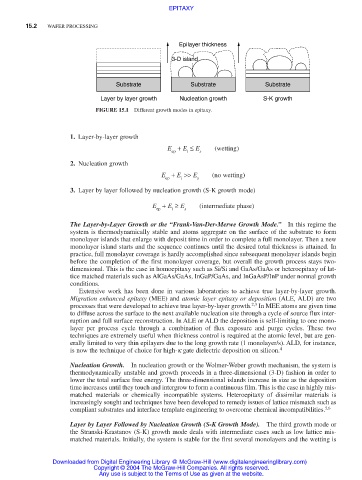
                                      FIGURE 15.1  Different growth modes in epitaxy.


                               1. Layer-by-layer growth
                                                         E + E ≤ E    (wetting)
                                                          ep   i  s
                               2. Nucleation growth
                                                        E + E >> E   (no wetting)
                                                         ep  i   s
                               3. Layer by layer followed by nucleation growth (S-K growth mode)

                                                     E + E ≥ E    (intermediate phase)
                                                      ep   i  s
                               The Layer-by-Layer Growth or the “Frank-Van-Der-Merwe Growth Mode.”  In this regime the
                               system is thermodynamically stable and atoms aggregate on the surface of the substrate to form
                               monolayer islands that enlarge with deposit time in order to complete a full monolayer. Then a new
                               monolayer island starts and the sequence continues until the desired total thickness is attained. In
                               practice, full monolayer coverage is hardly accomplished since subsequent monolayer islands begin
                               before the completion of the first monolayer coverage, but overall the growth process stays two-
                               dimensional. This is the case in homoepitaxy such as Si/Si and GaAs/GaAs or heteroepitaxy of lat-
                               tice matched materials such as AlGaAs/GaAs, InGaP/GaAs, and InGaAsP/InP under normal growth
                               conditions.
                                 Extensive work has been done in various laboratories to achieve true layer-by-layer growth.
                               Migration enhanced epitaxy (MEE) and atomic layer epitaxy or deposition (ALE, ALD) are two
                               processes that were developed to achieve true layer-by-layer growth. 2,3  In MEE atoms are given time
                               to diffuse across the surface to the next available nucleation site through a cycle of source flux inter-
                               ruption and full surface reconstruction. In ALE or ALD the deposition is self-limiting to one mono-
                               layer per process cycle through a combination of flux exposure and purge cycles.  These two
                               techniques are extremely useful when thickness control is required at the atomic level, but are gen-
                               erally limited to very thin epilayers due to the long growth rate (1 monolayer/s). ALD, for instance,
                               is now the technique of choice for high-k gate dielectric deposition on silicon. 4

                               Nucleation Growth.  In nucleation growth or the Wolmer-Weber growth mechanism, the system is
                               thermodynamically unstable and growth proceeds in a three-dimensional (3-D) fashion in order to
                               lower the total surface free energy. The three-dimensional islands increase in size as the deposition
                               time increases until they touch and intergrow to form a continuous film. This is the case in highly mis-
                               matched materials or chemically incompatible systems. Heteroepitaxy of dissimilar materials is
                               increasingly sought and techniques have been developed to remedy issues of lattice mismatch such as
                               compliant substrates and interface template engineering to overcome chemical incompatibilities. 5,6

                               Layer by Layer Followed by Nucleation Growth (S-K Growth Mode).  The third growth mode or
                               the Stranski-Krastanov (S-K) growth mode deals with intermediate cases such as low lattice mis-
                               matched materials. Initially, the system is stable for the first several monolayers and the wetting is


                          Downloaded from Digital Engineering Library @ McGraw-Hill (www.digitalengineeringlibrary.com)
                                     Copyright © 2004 The McGraw-Hill Companies. All rights reserved.
                                       Any use is subject to the Terms of Use as given at the website.

