


Page 219 - Semiconductor Manufacturing Handbook
P. 219
Geng(SMH)_CH15.qxd  04/04/2005  19:53  Page 15.4


                                                          EPITAXY

                   15.4  WAFER PROCESSING

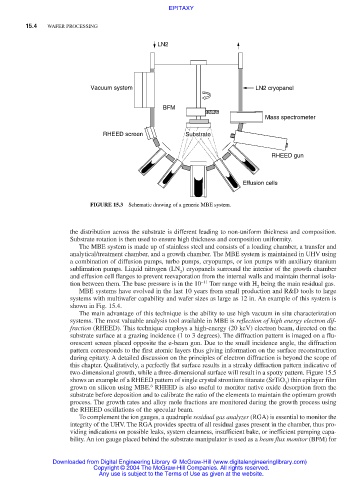
                                                       LN2


                                     Vacuum system                               LN2 cryopanel

                                                        BFM
                                                                                    Mass spectrometer

                                        RHEED screen          Substrate

                                                                                     RHEED gun


                                                                              Effusion cells

                                    FIGURE 15.3  Schematic drawing of a generic MBE system.


                               the distribution across the substrate is different leading to non-uniform thickness and composition.
                               Substrate rotation is then used to ensure high thickness and composition uniformity.
                                 The MBE system is made up of stainless steel and consists of a loading chamber, a transfer and
                               analytical/treatment chamber, and a growth chamber. The MBE system is maintained in UHV using
                               a combination of diffusion pumps, turbo pumps, cryopumps, or ion pumps with auxiliary titanium
                               sublimation pumps. Liquid nitrogen (LN ) cryopanels surround the interior of the growth chamber
                                                             2
                               and effusion cell flanges to prevent reevaporation from the internal walls and maintain thermal isola-
                               tion between them. The base pressure is in the 10 −11  Torr range with H being the main residual gas.
                                                                                  2
                                 MBE systems have evolved in the last 10 years from small production and R&D tools to large
                               systems with multiwafer capability and wafer sizes as large as 12 in. An example of this system is
                               shown in Fig. 15.4.
                                 The main advantage of this technique is the ability to use high vacuum in situ characterization
                               systems. The most valuable analysis tool available in MBE is reflection of high energy electron dif-
                               fraction (RHEED). This technique employs a high-energy (20 keV) electron beam, directed on the
                               substrate surface at a grazing incidence (1 to 3 degrees). The diffraction pattern is imaged on a flu-
                               orescent screen placed opposite the e-beam gun. Due to the small incidence angle, the diffraction
                               pattern corresponds to the first atomic layers thus giving information on the surface reconstruction
                               during epitaxy. A detailed discussion on the principles of electron diffraction is beyond the scope of
                               this chapter. Qualitatively, a perfectly flat surface results in a streaky diffraction pattern indicative of
                               two-dimensional growth, while a three-dimensional surface will result in a spotty pattern. Figure 15.5
                               shows an example of a RHEED pattern of single crystal strontium titanate (SrTiO ) thin epilayer film
                                                                                         3
                                                     6
                               grown on silicon using MBE. RHEED is also useful to monitor native oxide desorption from the
                               substrate before deposition and to calibrate the ratio of the elements to maintain the optimum growth
                               process. The growth rates and alloy mole fractions are monitored during the growth process using
                               the RHEED oscillations of the specular beam.
                                 To complement the ion gauges, a quadruple residual gas analyzer (RGA) is essential to monitor the
                               integrity of the UHV. The RGA provides spectra of all residual gases present in the chamber, thus pro-
                               viding indications on possible leaks, system cleanness, insufficient bake, or inefficient pumping capa-
                               bility. An ion gauge placed behind the substrate manipulator is used as a beam flux monitor (BFM) for


                          Downloaded from Digital Engineering Library @ McGraw-Hill (www.digitalengineeringlibrary.com)
                                     Copyright © 2004 The McGraw-Hill Companies. All rights reserved.
                                       Any use is subject to the Terms of Use as given at the website.

