


Page 224 - Semiconductor Manufacturing Handbook
P. 224
Geng(SMH)_CH15.qxd  04/04/2005  19:53  Page 15.9


                                                             EPITAXY

                                                                                              EPITAXY  15.9


                                                Laminar flow                 Boundary layer

                                                                            d b


                                               0                   x                Susceptor
                                              FIGURE 15.8  Boundary layer structure.


                                    The Reynolds number depends on the gas density (ρ), the gas velocity (ν) and gas viscosity (µ).
                                  The boundary layer structure is depicted in Fig. 15.8.
                                    This configuration will retain the flow in the laminar mode, that is, the gas flows in a regular, con-
                                  tinuous, and nonturbulent mode. Yet, the boundary layer thickness is not constant as the gas flow
                                  across the heated wafer surface leading to a nonuniform deposition rate along the flow direction and
                                  in the transverse direction. Therefore, wafer rotation in the azimuthal direction along with a special
                                  injector design for flow distribution control is added to achieve high thickness uniformity. Thorough
                                  treatment of the horizontal reactor process using computational fluid dynamics can be found in
                                  Ref.12 and Ref. 13.
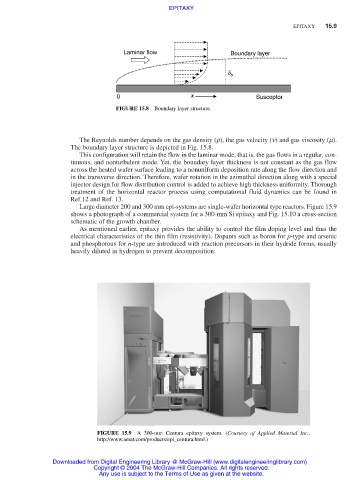
                                    Large diameter 200 and 300 mm epi-systems are single-wafer horizontal type reactors. Figure 15.9
                                  shows a photograph of a commercial system for a 300-mm Si epitaxy and Fig. 15.10 a cross-section
                                  schematic of the growth chamber.
                                    As mentioned earlier, epitaxy provides the ability to control the film doping level and thus the
                                  electrical characteristics of the thin film (resistivity). Dopants such as boron for p-type and arsenic
                                  and phosphorous for n-type are introduced with reaction precursors in their hydride forms, usually
                                  heavily diluted in hydrogen to prevent decomposition:


                                         FIGURE 15.9  A 300-mm Centura epitaxy system. (Courtesy of  Applied Material Inc.,
                                         http://www.amat.com/products/epi_centura.html.)


                             Downloaded from Digital Engineering Library @ McGraw-Hill (www.digitalengineeringlibrary.com)
                                        Copyright © 2004 The McGraw-Hill Companies. All rights reserved.
                                          Any use is subject to the Terms of Use as given at the website.

