


Page 226 - Semiconductor Manufacturing Handbook
P. 226
Geng(SMH)_CH15.qxd  04/04/2005  19:53  Page 15.11


                                                             EPITAXY

                                                                                             EPITAXY  15.11


                                               (a)                   (b)                   (c)
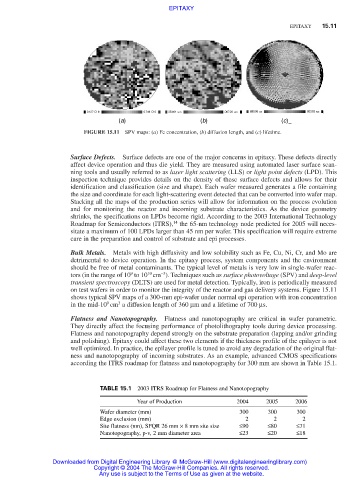
                                      FIGURE 15.11  SPV maps: (a) Fe concentration, (b) diffusion length, and (c) lifetime.


                                  Surface Defects.  Surface defects are one of the major concerns in epitaxy. These defects directly
                                  affect device operation and thus die yield. They are measured using automated laser surface scan-
                                  ning tools and usually referred to as laser light scattering (LLS) or light point defects (LPD). This
                                  inspection technique provides details on the density of these surface defects and allows for their
                                  identification and classification (size and shape). Each wafer measured generates a file containing
                                  the size and coordinate for each light-scattering event detected that can be converted into wafer map.
                                  Stacking all the maps of the production series will allow for information on the process evolution
                                  and for monitoring the reactor and incoming substrate characteristics.  As the device geometry
                                  shrinks, the specifications on LPDs become rigid. According to the 2003 International Technology
                                                              14
                                  Roadmap for Semiconductors (ITRS), the 65-nm technology node predicted for 2005 will neces-
                                  sitate a maximum of 100 LPDs larger than 45 nm per wafer. This specification will require extreme
                                  care in the preparation and control of substrate and epi processes.
                                  Bulk Metals.  Metals with high diffusivity and low solubility such as Fe, Cu, Ni, Cr, and Mo are
                                  detrimental to device operation. In the epitaxy process, system components and the environment
                                  should be free of metal contaminants. The typical level of metals is very low in single-wafer reac-
                                                          −3
                                                       10
                                                  9
                                  tors (in the range of 10 to 10 cm ). Techniques such as surface photovoltage (SPV) and deep-level
                                  transient spectroscopy (DLTS) are used for metal detection. Typically, iron is periodically measured
                                  on test wafers in order to monitor the integrity of the reactor and gas delivery systems. Figure 15.11
                                  shows typical SPV maps of a 300-mm epi-wafer under normal epi operation with iron concentration
                                            9
                                  in the mid-10 cm a diffusion length of 360 µm and a lifetime of 700 µs.
                                               3
                                  Flatness and Nanotopography.  Flatness and nanotopography are critical in wafer parametric.
                                  They directly affect the focusing performance of photolithography tools during device processing.
                                  Flatness and nanotopography depend strongly on the substrate preparation (lapping and/or grinding
                                  and polishing). Epitaxy could affect these two elements if the thickness profile of the epilayer is not
                                  well optimized. In practice, the epilayer profile is tuned to avoid any degradation of the original flat-
                                  ness and nanotopography of incoming substrates. As an example, advanced CMOS specifications
                                  according the ITRS roadmap for flatness and nanotopography for 300 mm are shown in Table 15.1.


                                          TABLE 15.1 2003 ITRS Roadmap for Flatness and Nanotopography
                                                    Year of Production         2004    2005    2006
                                          Wafer diameter (mm)                   300    300     300
                                          Edge exclusion (mm)                    2       2       2
                                          Site flatness (nm), SFQR 26 mm × 8 mm site size  ≤90  ≤80  ≤71
                                          Nanotopography, p-v, 2 mm diameter area  ≤23  ≤20    ≤18


                             Downloaded from Digital Engineering Library @ McGraw-Hill (www.digitalengineeringlibrary.com)
                                        Copyright © 2004 The McGraw-Hill Companies. All rights reserved.
                                          Any use is subject to the Terms of Use as given at the website.

