


Page 227 - Semiconductor Manufacturing Handbook
P. 227
Geng(SMH)_CH15.qxd  04/04/2005  19:53  Page 15.12


                                                          EPITAXY

                   15.12  WAFER PROCESSING

                                 However, customer requirements are often one to two generations ahead of the general trend and
                               pressurize the epitaxial wafer producers to develop products at a greater pace than the customer
                               requirements. R&D epitaxy laboratories have already produced epitaxial wafers with state-of-the-art
                               flatness, nanotopography, and LPDs.
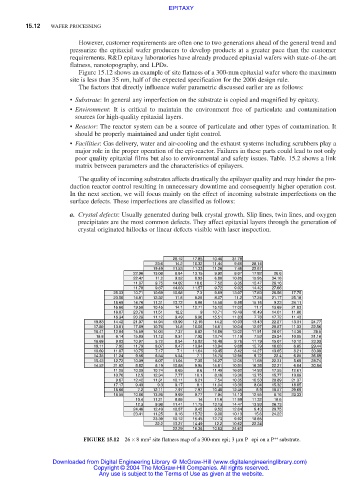
                                 Figure 15.12 shows an example of site flatness of a 300-mm epitaxial wafer where the maximum
                               site is less than 35 nm, half of the expected specification for the 2006 design rule.
                                 The factors that directly influence wafer parametric discussed earlier are as follows:
                               • Substrate: In general any imperfection on the substrate is copied and magnified by epitaxy.
                               • Environment: It is critical to maintain the environment free of particulate and contamination
                                sources for high-quality epitaxial layers.
                               • Reactor: The reactor system can be a source of particulate and other types of contamination. It
                                should be properly maintained and under tight control.
                               • Facilities: Gas delivery, water and air-cooling and the exhaust systems including scrubbers play a
                                major role in the proper operation of the epi-reactor. Failures in these parts could lead to not only
                                poor quality epitaxial films but also to environmental and safety issues. Table. 15.2 shows a link
                                matrix between parameters and the characteristics of epilayers.
                                 The quality of incoming substrates affects drastically the epilayer quality and may hinder the pro-
                               duction reactor control resulting in unnecessary downtime and consequently higher operation cost.
                               In the next section, we will focus mainly on the effect of incoming substrate imperfections on the
                               surface defects. These imperfections are classified as follows:
                               a. Crystal defects: Usually generated during bulk crystal growth. Slip lines, twin lines, and oxygen
                                 precipitates are the most common defects. They affect epitaxial layers through the generation of
                                 crystal originated hillocks or linear defects visible with laser inspection.


                                                           26.12  17.85  10.48  31.78
                                                      23.6  14.2  10.32  11.44  9.66  28.14
                                                     19.49  11.53  11.33  11.26  7.46  22.67
                                                22.96  13.08  6.84  13.15  9.92  8.07  17.82  26.6
                                                22.47  11.2  9.52  8.93  6.88  10.85  15.95  34.16
                                                11.07  9.75  14.02  10.6  7.52  8.35  15.47  28.16
                                                11.78  9.67  14.63  11.57  9.72  9.02  14.42  27.66
                                           25.33  10.71  10.69  10.68  7.3  9.69  13.07  17.83  26.56  17.75
                                           23.56  14.81  12.32  11.8  8.29  8.07  11.2  17.24  21.17  25.18
                                           18.69  14.76  11.31  13.72  8.06  15.58  9.88  15.16  9.23  24.11
                                           16.66  19.58  10.45  14.1  12.71  15.12  17.02  11.7  13.69  21.03
                                           18.07  23.76  11.51  12.2  9  10.71  19.49  10.49  14.01  11.86
                                           18.34  20.28  11.12  9.49  8.96  15.51  11.83  7.78  17.72  11.43
                                     18.83  14.42  21.97  14.94  13.99  12.16  14.2  10.93  13.43  22.27  13.31  24.77
                                     17.89  13.01  17.69  10.76  14.8  10.06  14.61  10.04  12.97  20.87  11.33  22.56
                                     16.41  12.04  15.59  14.04  7.37  8.82  14.86  13.02  11.91  20.07  14.36  28.5
                                      18.8  6.14  15.83  11.12  8.31  7.92  13.74  11.19  7.53  23.24  10.95  31.18
                                     16.69  9.03  10.97  5.72  8.54  15.82  16.48  9.76  11.79  15.07  10.12  23.03
                                     18.11  7.95  11.79  8.07  8.47  13.94  13.94  9.68  15.79  16.03  6.85  29.44
                                     10.69  11.07  10.75  7.17  7.1  11.64  19.45  8.42  14.27  19.65  8.21  33.99
                                     14.35  11.24  9.56  8.54  5.54  7.1  15.75  12.95  9.72  22.4  6.85  36.69
                                     15.43  12.72  10.09  8.07  11.04  7.35  16.27  12.06  11.68  22.31  5.69  28.74
                                     14.52  21.02  8.82  8.19  10.88  9.95  15.61  10.81  16.38  22.27  6.04  30.84
                                           11.25  10.09  10.74  6.65  8.6  11.49  16.02  14.93  17.55  12.61
                                           10.76  12.5  12.34  7.77  10.1  8.16  13.36  13.75  15.77  19.09
                                           9.67  12.42  11.31  10.11  6.21  7.54  10.35  10.53  20.89  21.37
                                           17.17  9.49  9.3  9.17  8.1  11.04  13.36  8.04  15.32  18.85
                                           18.66  7.2  12.11  7.97  7.97  10.48  12.45  8.9  10.57  29.69
                                           18.55  10.66  13.26  9.69  9.77  7.94  14.13  12.55  8.16  23.33
                                                 10.4  11.21  8.89  14  11.6  11.99  11.32  16.6
                                                 12.3  9.98  11.41  11.75  13.13  14.47  13.93  26.73
                                                24.46  12.49  10.57  9.45  9.52  12.64  9.43  29.75
                                                23.41  11.25  9.16  15.72  9.08  10.13  15.6  24.22
                                                     23.39  10.12  15.45  12.73  9.92  18.65
                                                      22.2  13.27  14.49  12.2  10.62  22.24
                                                           22.29  16.38  10.63  24.61
                                                                               −
                                                                                      ++
                                                    2
                                   FIGURE 15.12  26 × 8 mm site flatness map of a 300-mm epi; 3 µm P epi on a P substrate.
                          Downloaded from Digital Engineering Library @ McGraw-Hill (www.digitalengineeringlibrary.com)
                                     Copyright © 2004 The McGraw-Hill Companies. All rights reserved.
                                       Any use is subject to the Terms of Use as given at the website.

