


Page 228 - Semiconductor Manufacturing Handbook
P. 228
Geng(SMH)_CH15.qxd  04/04/2005  19:53  Page 15.13


                                                             EPITAXY

                                                                                             EPITAXY  15.13

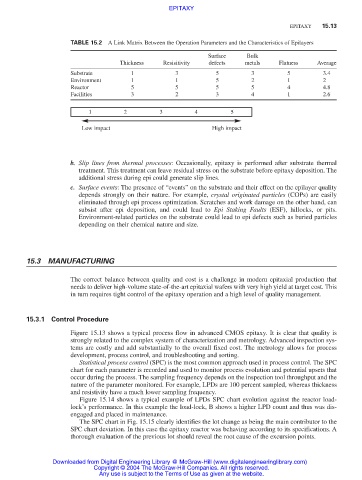
                                  TABLE 15.2 A Link Matrix Between the Operation Parameters and the Characteristics of Epilayers
                                                                       Surface    Bulk
                                               Thickness   Resisitivity  defects  metals  Flatness   Average
                                  Substrate       1           3          5         3         5        3.4
                                  Environment     1           1          5         2         1        2
                                  Reactor         5           5          5         5         4        4.8
                                  Facilities      3           2          3         4         1        2.6

                                       1        2         3         4        5

                                     Low impact                         High impact


                                  b. Slip lines from thermal processes: Occasionally, epitaxy is performed after substrate thermal
                                    treatment. This treatment can leave residual stress on the substrate before epitaxy deposition. The
                                    additional stress during epi could generate slip lines.
                                  c. Surface events: The presence of “events” on the substrate and their effect on the epilayer quality
                                    depends strongly on their nature. For example, crystal originated particles (COPs) are easily
                                    eliminated through epi process optimization. Scratches and work damage on the other hand, can
                                    subsist after epi deposition, and could lead to  Epi Staking Faults (ESF), hillocks, or pits.
                                    Environment-related particles on the substrate could lead to epi defects such as buried particles
                                    depending on their chemical nature and size.


                      15.3 MANUFACTURING

                                  The correct balance between quality and cost is a challenge in modern epitaxial production that
                                  needs to deliver high-volume state-of-the-art epitaxial wafers with very high yield at target cost. This
                                  in turn requires tight control of the epitaxy operation and a high level of quality management.


                      15.3.1 Control Procedure
                                  Figure 15.13 shows a typical process flow in advanced CMOS epitaxy. It is clear that quality is
                                  strongly related to the complex system of characterization and metrology. Advanced inspection sys-
                                  tems are costly and add substantially to the overall fixed cost. The metrology allows for process
                                  development, process control, and troubleshooting and sorting.
                                    Statistical process control (SPC) is the most common approach used in process control. The SPC
                                  chart for each parameter is recorded and used to monitor process evolution and potential upsets that
                                  occur during the process. The sampling frequency depends on the inspection tool throughput and the
                                  nature of the parameter monitored. For example, LPDs are 100 percent sampled, whereas thickness
                                  and resistivity have a much lower sampling frequency.
                                    Figure 15.14 shows a typical example of LPDs SPC chart evolution against the reactor load-
                                  lock’s performance. In this example the load-lock, B shows a higher LPD count and thus was dis-
                                  engaged and placed in maintenance.
                                    The SPC chart in Fig. 15.15 clearly identifies the lot change as being the main contributor to the
                                  SPC chart deviation. In this case the epitaxy reactor was behaving according to its specifications. A
                                  thorough evaluation of the previous lot should reveal the root cause of the excursion points.


                             Downloaded from Digital Engineering Library @ McGraw-Hill (www.digitalengineeringlibrary.com)
                                        Copyright © 2004 The McGraw-Hill Companies. All rights reserved.
                                          Any use is subject to the Terms of Use as given at the website.

