


Page 218 - Semiconductor Manufacturing Handbook
P. 218
Geng(SMH)_CH15.qxd  04/04/2005  19:53  Page 15.3


                                                             EPITAXY

                                                                                              EPITAXY  15.3

                                  complete. As the thickness increases, the total surface free energy increases, and a breakdown occurs
                                  followed by a three-dimensional growth. Pseudomorphic structures such as GaInAs/GaAs and
                                  SiGe/Si are a few examples where the S-K mode growth process is applied.

                      15.1.2 Growth Techniques and Equipment
                                  Varieties of methods are used to grow crystalline materials on crystalline substrates. In the semi-
                                  conductor industry two major techniques are well established—chemical vapor deposition (CVD)
                                  and molecular beam epitaxy (MBE). Both techniques are of nonequilibrium character. Variants of
                                  these techniques—metal-organic chemical vapor deposition (MOCVD)—are associated with the
                                  epitaxy of compound semiconductors arsenides-, phosphides-, and nitrides-based materials, and
                                  chemical beam epitaxy  (CBE) or  gas source  MBE (GSMBE) where the elemental sources are
                                  gaseous instead of solid sources. A combination of CVD and ultrahigh vacuum deposition system
                                  (UHV-CVD) is generating acceptance in some applications such as the SiGe/Si materials system. 7

                      15.1.3 Molecular Beam Epitaxy
                                                            8
                                  In molecular beam epitaxy (MBE), epitaxy is induced by the flux of atoms/molecules onto a heat-
                                  ed substrate in a high vacuum environment. The mean free path is large enough so that the imping-
                                  ing atomic or molecular fluxes are ballistic in nature and with no gas-phase interactions. The growth
                                  conditions are such that the sticking coefficient of low vapor pressure elements is near unity and high
                                  vapor pressure elements are used in excess to compensate for their lower sticking coefficient. Surface
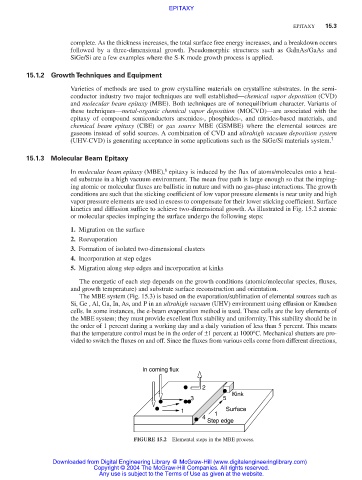
                                  kinetics and diffusion suffice to achieve two-dimensional growth. As illustrated in Fig. 15.2 atomic
                                  or molecular species impinging the surface undergo the following steps:

                                  1. Migration on the surface
                                  2. Reevaporation
                                  3. Formation of isolated two-dimensional clusters
                                  4. Incorporation at step edges
                                  5. Migration along step edges and incorporation at kinks
                                    The energetic of each step depends on the growth conditions (atomic/molecular species, fluxes,
                                  and growth temperature) and substrate surface reconstruction and orientation.
                                    The MBE system (Fig. 15.3) is based on the evaporation/sublimation of elemental sources such as
                                  Si, Ge , Al, Ga, In, As, and P in an ultrahigh vacuum (UHV) environment using effusion or Knudsen
                                  cells. In some instances, the e-beam evaporation method is used. These cells are the key elements of
                                  the MBE system; they must provide excellent flux stability and uniformity. This stability should be in
                                  the order of 1 percent during a working day and a daily variation of less than 5 percent. This means
                                  that the temperature control must be in the order of ±1 percent at 1000°C. Mechanical shutters are pro-
                                  vided to switch the fluxes on and off. Since the fluxes from various cells come from different directions,


                                                     In coming flux

                                                                      2
                                                                              Kink
                                                                  3        5
                                                                1        1   Surface
                                                                      4
                                                                       Step edge

                                                   FIGURE 15.2  Elemental steps in the MBE process.


                             Downloaded from Digital Engineering Library @ McGraw-Hill (www.digitalengineeringlibrary.com)
                                        Copyright © 2004 The McGraw-Hill Companies. All rights reserved.
                                          Any use is subject to the Terms of Use as given at the website.

