


Page 247 - Semiconductor Manufacturing Handbook
P. 247
Geng(SMH)_CH17.qxd  04/04/2005  19:57  Page 17.2


                                               CHEMICAL MECHANICAL POLISHING

                   17.2  WAFER PROCESSING

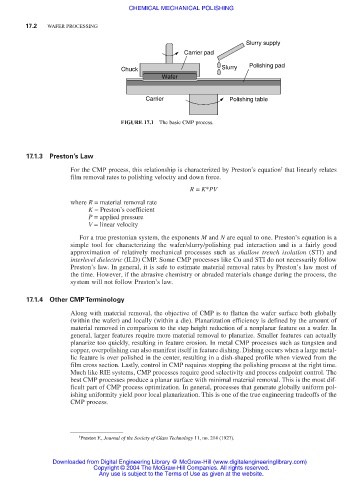
                                                                               Slurry supply
                                                              Carrier pad

                                             Chuck                      Slurry  Polishing pad
                                                        Wafer


                                                   Carrier                Polishing table


                                             FIGURE 17.1  The basic CMP process.


                   17.1.3 Preston’s Law
                                                                                        †
                               For the CMP process, this relationship is characterized by Preston’s equation that linearly relates
                               film removal rates to polishing velocity and down force.
                                                               R = K*PV
                               where R = material removal rate
                                    K = Preston’s coefficient
                                    P = applied pressure
                                    V = linear velocity
                                 For a true prestonian system, the exponents M and N are equal to one. Preston’s equation is a
                               simple tool for characterizing the wafer/slurry/polishing pad interaction and is a fairly good
                               approximation of relatively mechanical processes such as  shallow trench isolation (STI) and
                               interlevel dielectric (ILD) CMP. Some CMP processes like Cu and STI do not necessarily follow
                               Preston’s law. In general, it is safe to estimate material removal rates by Preston’s law most of
                               the time. However, if the abrasive chemistry or abraded materials change during the process, the
                               system will not follow Preston’s law.
                   17.1.4 Other CMP Terminology

                               Along with material removal, the objective of CMP is to flatten the wafer surface both globally
                               (within the wafer) and locally (within a die). Planarization efficiency is defined by the amount of
                               material removed in comparison to the step height reduction of a nonplanar feature on a wafer. In
                               general, larger features require more material removal to planarize. Smaller features can actually
                               planarize too quickly, resulting in feature erosion. In metal CMP processes such as tungsten and
                               copper, overpolishing can also manifest itself in feature dishing. Dishing occurs when a large metal-
                               lic feature is over polished in the center, resulting in a dish-shaped profile when viewed from the
                               film cross section. Lastly, control in CMP requires stopping the polishing process at the right time.
                               Much like RIE systems, CMP processes require good selectivity and process endpoint control. The
                               best CMP processes produce a planar surface with minimal material removal. This is the most dif-
                               ficult part of CMP process optimization. In general, processes that generate globally uniform pol-
                               ishing uniformity yield poor local planarization. This is one of the true engineering tradeoffs of the
                               CMP process.


                                 † Preston F., Journal of the Society of Glass Technology 11, no. 214 (1927).


                          Downloaded from Digital Engineering Library @ McGraw-Hill (www.digitalengineeringlibrary.com)
                                     Copyright © 2004 The McGraw-Hill Companies. All rights reserved.
                                       Any use is subject to the Terms of Use as given at the website.

