


Page 242 - Semiconductor Manufacturing Handbook
P. 242
Geng(SMH)_CH16.qxd  04/04/2005  19:54  Page 16.9


                                                        ECD FUNDAMENTALS

                                                                                      ECD FUNDAMENTALS  16.9

                      16.6 FUTURE TRENDS

                                  With each technology node, interconnect size decreases and the current density in interconnects
                                  increases. (According to the International Technology Roadmap for Semiconductors, the current den-
                                                                                           38
                                  sity will approximately double from the 130-nm to the 45-nm node technology. ) This translates to
                                  higher line resistance and increased susceptibility to electromigration. Semiconductor companies are
                                  actively pursuing techniques to manage both of these factors.
                                    As feature sizes become smaller, the percentage of the interconnect filled by the barrier layer
                                  becomes more significant. In addition to this, the size of the interconnect feature is approaching the
                                  electron mean-free path in copper, causing the resistivity to increase due to surface scattering of elec-
                                  trons. To minimize line resistance, barrier layers must become thinner, smoother, and more conduc-
                                  tive, while continuing to prevent diffusion of copper atoms into the dielectric material. The minimal
                                  barrier thickness is determined by the conformality of the deposit. For this reason, atomic layer
                                  deposition (ALD)—a derivative of CVD technology—looks very promising. ALD processes deposit
                                  barrier materials with nearly 100 percent conformality. Chip manufacturers are also investigating
                                  higher-conductivity barrier materials including ruthenium and tungsten.
                                    Current process technology utilizes either a blanket layer of silicon nitride or silicon carbide (or
                                  a combination) to cap the copper lines after CMP. This insulating layer provides sufficient protec-
                                  tion against copper diffusion and serves as an etch stop. However, electromigration occurs primarily
                                                                      39
                                  along this interface, reducing the device lifetime. This layer also has a relatively high dielectric
                                  constant, which increases the effective dielectric constant of the dielectric stack. To achieve effective
                                  dielectric constants significantly below 3.0, the blanket-capping layer must be either changed or
                                  eliminated. 40
                                    Metal capping layers reduce the mobility of copper along the top interface of interconnect
                                  lines. This extends the electromigration lifetime by more than ten-fold. 41  To prevent shorts or
                                  leakage, the layer must be selectively deposited only on top of the copper. This selectivity can be
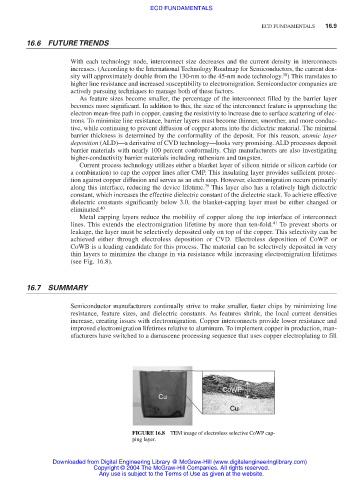
                                  achieved either through electroless deposition or CVD. Electroless deposition of CoWP or
                                  CoWB is a leading candidate for this process. The material can be selectively deposited in very
                                  thin layers to minimize the change in via resistance while increasing electromigration lifetimes
                                  (see Fig. 16.8).


                      16.7 SUMMARY


                                  Semiconductor manufacturers continually strive to make smaller, faster chips by minimizing line
                                  resistance, feature sizes, and dielectric constants. As features shrink, the local current densities
                                  increase, creating issues with electromigration. Copper interconnects provide lower resistance and
                                  improved electromigration lifetimes relative to aluminum. To implement copper in production, man-
                                  ufacturers have switched to a damascene processing sequence that uses copper electroplating to fill


                                                                           CoWP
                                                          Cu
                                                                             Cu


                                                   FIGURE 16.8  TEM image of electroless selective CoWP cap-
                                                   ping layer.


                             Downloaded from Digital Engineering Library @ McGraw-Hill (www.digitalengineeringlibrary.com)
                                        Copyright © 2004 The McGraw-Hill Companies. All rights reserved.
                                          Any use is subject to the Terms of Use as given at the website.

