


Page 237 - Semiconductor Manufacturing Handbook
P. 237
Geng(SMH)_CH16.qxd  04/04/2005  19:54  Page 16.4


                                                     ECD FUNDAMENTALS

                   16.4  WAFER PROCESSING

                               current density (Fig. 16.2) in order to produce smooth deposits with consistent morphology. Limiting
                               current density is a reasonable measure of the relative deposition speed capability of different sys-
                               tems. The factors that increase the diffusion rate of metal ions to the cathode surface have the most
                               impact on increasing the limiting current density of an ECD system. These factors are agitation (such
                               as flow and spin speed), temperature, and metal ion concentration.
                                 Superconformal deposition is the deposition property that enabled electrolytic deposition
                               processes to be utilized for copper deposition in a damascene metallization scheme. 7–10  This is the
                               ability of the process to provide a higher deposition rate, or coverage, at the bottom of an etched fea-
                               ture than in the field region on top. This property, which results from the combination of suppressors
                               and accelerators in the bath, 11,12  enables the process to be used to fill high-aspect-ratio features with
                               subconformal PVD seed layers. Extensive references are available on the two theories that explain this
                               behavior—consumption of diffusion-limited suppressing agents and curvature-enhanced catalytic
                               enhancement. 7–9,13,14
                                 Copper can be electrolytically deposited from several types of solutions—acidic copper sulfate,
                               methane sulfonic acid, basic cyanide complexed chemistries, pyrophosphate baths, and many other
                               specialized chemistries; some of which contain complexing agents. Most copper deposition for
                               semiconductor processing, however, is done using relatively simple acidic copper sulfate chemistry.
                               These baths typically consist of three inorganic components—sulfuric acid, copper sulfate, and
                               hydrochloric acid—with some organic compounds to modify the deposition and film properties. These
                               organic additives are usually named after their functions, with names such as suppressors, accelerators,
                               and levelers.
                                 Copper sulfate provides the source of copper ions that are electrolytically deposited during the
                               plating operation. The higher the concentration of copper ions in solution, the better the feature-
                               filling performance of the chemistry. Sulfuric acid is used to maintain an acid environment to keep
                                                                                       +
                               copper in solution and to provide the ionic conductivity of the solution. The H ions, or protons, are
                               the preferred charge carriers in the solution and provide high solution conductivity. The pH of the
                               solution also affects the activity of the organic additives. The concentrations of copper sulfate and
                               sulfuric acid are not completely independent since the common ion effect limits the total solution
                                                   15
                               concentration of sulfate ion. This sets the upper limit on the total concentration of these two chem-
                               icals. Hydrochloric acid is added to these solutions to assist the effectiveness of some organic addi-
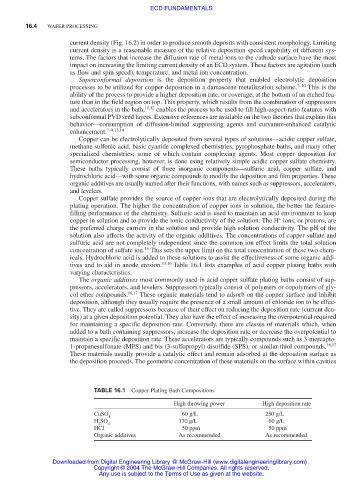
                               tives and to aid in anode erosion. 13,16  Table 16.1 lists examples of acid copper plating baths with
                               varying characteristics.
                                 The organic additives most commonly used in acid copper sulfate plating baths consist of sup-
                               pressors, accelerators, and levelers. Suppressors typically consist of polymers or copolymers of gly-
                               col ether compounds. 16,17  These organic materials tend to adsorb on the copper surface and inhibit
                               deposition, although they usually require the presence of a small amount of chloride ion to be effec-
                               tive. They are called suppressors because of their effect on reducing the deposition rate (current den-
                               sity) at a given deposition potential. They also have the effect of increasing the overpotential required
                               for maintaining a specific deposition rate. Conversely, there are classes of materials which, when
                               added to a bath containing suppressors, increase the deposition rate or decrease the overpotential to
                               maintain a specific deposition rate. These accelerators are typically compounds such as 3-mercapto-
                               1-propanesulfonate (MPS) and bis (3-sulfopropyl) disulfide (SPS), or similar thiol compounds. 16,17
                               These materials usually provide a catalytic effect and remain adsorbed at the deposition surface as
                               the deposition proceeds. The geometric concentration of these materials on the surface within cavities


                                     TABLE 16.1 Copper Plating Bath Compositions
                                                           High throwing power     High deposition rate
                                     CuSO                    60 g/L                 250 g/L
                                         4
                                     H SO                   170 g/L                  60 g/L
                                       2  4
                                     HCl                     50 ppm                  50 ppm
                                     Organic additives      As recommended          As recommended

                          Downloaded from Digital Engineering Library @ McGraw-Hill (www.digitalengineeringlibrary.com)
                                     Copyright © 2004 The McGraw-Hill Companies. All rights reserved.
                                       Any use is subject to the Terms of Use as given at the website.

