


Page 236 - Semiconductor Manufacturing Handbook
P. 236
Geng(SMH)_CH16.qxd  04/04/2005  19:54  Page 16.3


                                                        ECD FUNDAMENTALS

                                                                                      ECD FUNDAMENTALS  16.3

                                    Industrial processes are typically operated in current-control mode that is analogous to control-
                                  ling the deposition rate. In such a case, the voltage increases to the point necessary to drive the chem-
                                  ical reaction(s) necessary to support the current in the system.
                                    The electrochemical reactions at the electrodes in an electrodeposition system consume reactants
                                  and create reaction products. This leads to the importance of mass transfer to carry these reactants
                                  and products to the surface of the electrode within the electrolyte. Typically, mass transfer effects
                                  are explained relative to the metal being deposited at the cathode. It is important to remember,
                                  however, that mass transfer is also critical for the other bath components and at the anode, as well
                                  as the cathode.
                                    In a typical ECD cell, the source of the metal being deposited is considered to be the electrolyte
                                  very near the electrode (cathode). This is in contrast to a vacuum deposition process such as sput-
                                  tering, in which the mean free path is very large and the source of the deposited material is the
                                  counter-electrode, or target. The metal ions are consumed by the reduction reaction at the cathode
                                  (Eq. (16.1a)) and the concentration of these ions is reduced in a region very near the electrode sur-
                                  face. As the reaction proceeds, this leads to the formation of a region of reduced concentration called
                                  the diffusion boundary layer. The concentration gradient in this diffusion boundary layer is the dri-
                                  ving force for the transport of the ionic reactant to the cathode surface. The balance of the diffusion
                                  rate to the reaction rate is a critical parameter in electrolytic systems.
                                    If the current is increased to the point at which every metal ion is consumed as soon as it reaches
                                  the cathode surface, the diffusion rate across the diffusion boundary layer is at a maximum because
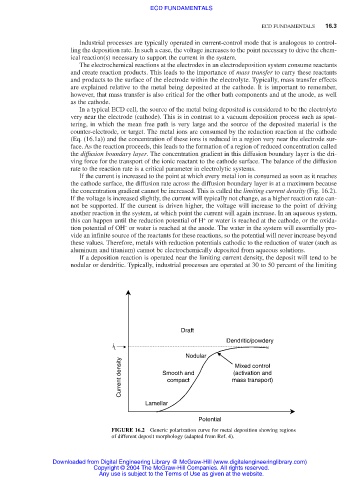
                                  the concentration gradient cannot be increased. This is called the limiting current density (Fig. 16.2).
                                  If the voltage is increased slightly, the current will typically not change, as a higher reaction rate can-
                                  not be supported. If the current is driven higher, the voltage will increase to the point of driving
                                  another reaction in the system, at which point the current will again increase. In an aqueous system,
                                                                      +
                                  this can happen until the reduction potential of H or water is reached at the cathode, or the oxida-
                                                 −
                                  tion potential of OH or water is reached at the anode. The water in the system will essentially pro-
                                  vide an infinite source of the reactants for these reactions, so the potential will never increase beyond
                                  these values. Therefore, metals with reduction potentials cathodic to the reduction of water (such as
                                  aluminum and titanium) cannot be electrochemically deposited from aqueous solutions.
                                    If a deposition reaction is operated near the limiting current density, the deposit will tend to be
                                  nodular or dendritic. Typically, industrial processes are operated at 30 to 50 percent of the limiting


                                                                Draft
                                                                            Dendritic/powdery
                                             i L
                                                                 Nodular      Mixed control
                                                Current density  Smooth and   mass transport)
                                                                              (activation and
                                                            compact


                                                      Lamellar

                                                                     Potential
                                             FIGURE 16.2  Generic polarization curve for metal deposition showing regions
                                             of different deposit morphology (adapted from Ref. 4).


                             Downloaded from Digital Engineering Library @ McGraw-Hill (www.digitalengineeringlibrary.com)
                                        Copyright © 2004 The McGraw-Hill Companies. All rights reserved.
                                          Any use is subject to the Terms of Use as given at the website.

