


Page 235 - Semiconductor Manufacturing Handbook
P. 235
Geng(SMH)_CH16.qxd  04/04/2005  19:54  Page 16.2


                                                     ECD FUNDAMENTALS

                   16.2  WAFER PROCESSING


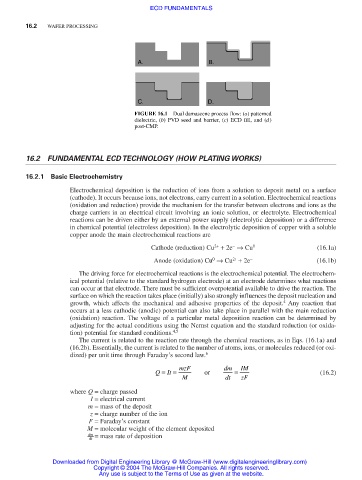
                                                 A.                 B.


                                                 C.                 D.
                                                FIGURE 16.1  Dual damascene process flow: (a) patterned
                                                dielectric, (b) PVD seed and barrier, (c) ECD fill, and (d)
                                                post-CMP.


                   16.2 FUNDAMENTAL ECD TECHNOLOGY (HOW PLATING WORKS)

                   16.2.1 Basic Electrochemistry
                               Electrochemical deposition is the reduction of ions from a solution to deposit metal on a surface
                               (cathode). It occurs because ions, not electrons, carry current in a solution. Electrochemical reactions
                               (oxidation and reduction) provide the mechanism for the transfer between electrons and ions as the
                               charge carriers in an electrical circuit involving an ionic solution, or electrolyte. Electrochemical
                               reactions can be driven either by an external power supply (electrolytic deposition) or a difference
                               in chemical potential (electroless deposition). In the electrolytic deposition of copper with a soluble
                               copper anode the main electrochemical reactions are
                                                                           −
                                                                      2+
                                                     Cathode (reduction) Cu + 2e → Cu 0           (16.1a)
                                                                           2+
                                                                     0
                                                      Anode (oxidation) Cu → Cu + 2e −            (16.1b)
                                 The driving force for electrochemical reactions is the electrochemical potential. The electrochem-
                               ical potential (relative to the standard hydrogen electrode) at an electrode determines what reactions
                               can occur at that electrode. There must be sufficient overpotential available to drive the reaction. The
                               surface on which the reaction takes place (initially) also strongly influences the deposit nucleation and
                                                                                         4
                               growth, which affects the mechanical and adhesive properties of the deposit. Any reaction that
                               occurs at a less cathodic (anodic) potential can also take place in parallel with the main reduction
                               (oxidation) reaction. The voltage of a particular metal deposition reaction can be determined by
                               adjusting for the actual conditions using the Nernst equation and the standard reduction (or oxida-
                               tion) potential for standard conditions. 4,5
                                 The current is related to the reaction rate through the chemical reactions, as in Eqs. (16.1a) and
                               (16.2b). Essentially, the current is related to the number of atoms, ions, or molecules reduced (or oxi-
                               dized) per unit time through Faraday’s second law. 6
                                                      Q =  It =  mzF  or  dm  =  IM                (16.2)
                                                             M           dt  zF
                               where Q = charge passed
                                     I = electrical current
                                    m = mass of the deposit
                                    z = charge number of the ion
                                    F = Faraday’s constant
                                    M = molecular weight of the element deposited
                                    dm  = mass rate of deposition
                                    dt


                          Downloaded from Digital Engineering Library @ McGraw-Hill (www.digitalengineeringlibrary.com)
                                     Copyright © 2004 The McGraw-Hill Companies. All rights reserved.
                                       Any use is subject to the Terms of Use as given at the website.

