


Page 240 - Semiconductor Manufacturing Handbook
P. 240
Geng(SMH)_CH16.qxd  04/04/2005  19:54  Page 16.7


                                                        ECD FUNDAMENTALS

                                                                                      ECD FUNDAMENTALS  16.7

                                    The copper ECD process typically deposits films with very small
                                                      25
                                  grains (0.03 µm to 0.1 µm). After processing, this film undergoes
                                  self-annealing, in which grain sizes grow significantly. 25–33  The
                                  resistivity of an electrolytically deposited blanket copper film will
                                                          34
                                  fall from 2.1 to about 1.8 µΩ-cm. This process can take from sev-
                                  eral days to months to occur, depending on the deposition condi-
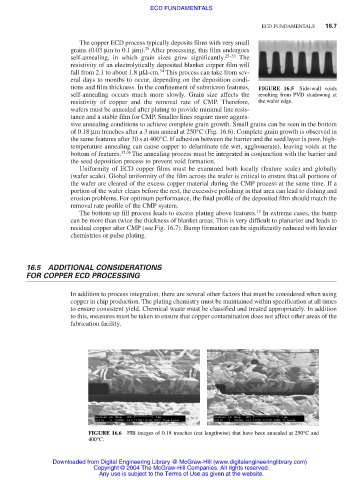
                                  tions and film thickness. In the confinement of submicron features,  FIGURE 16.5  Side-wall voids
                                  self-annealing occurs much more slowly. Grain size affects the  resulting from PVD shadowing at
                                  resistivity of copper and the removal rate of CMP.  Therefore,  the wafer edge.
                                  wafers must be annealed after plating to provide minimal line resis-
                                  tance and a stable film for CMP. Smaller lines require more aggres-
                                  sive annealing conditions to achieve complete grain growth. Small grains can be seen in the bottom
                                  of 0.18 µm trenches after a 3 min anneal at 250°C (Fig. 16.6). Complete grain growth is observed in
                                  the same features after 30 s at 400°C. If adhesion between the barrier and the seed layer is poor, high-
                                  temperature annealing can cause copper to delaminate (de wet, agglomerate), leaving voids at the
                                  bottom of features. 35,36  The annealing process must be integrated in conjunction with the barrier and
                                  the seed deposition process to prevent void formation.
                                    Uniformity of ECD copper films must be examined both locally (feature scale) and globally
                                  (wafer scale). Global uniformity of the film across the wafer is critical to ensure that all portions of
                                  the wafer are cleared of the excess copper material during the CMP process at the same time. If a
                                  portion of the wafer clears before the rest, the excessive polishing in that area can lead to dishing and
                                  erosion problems. For optimum performance, the final profile of the deposited film should match the
                                  removal rate profile of the CMP system.
                                                                                    13
                                    The bottom-up fill process leads to excess plating above features. In extreme cases, the bump
                                  can be more than twice the thickness of blanket areas. This is very difficult to planarize and leads to
                                  residual copper after CMP (see Fig. 16.7). Bump formation can be significantly reduced with leveler
                                  chemistries or pulse plating.


                      16.5 ADDITIONAL CONSIDERATIONS
                      FOR COPPER ECD PROCESSING


                                  In addition to process integration, there are several other factors that must be considered when using
                                  copper in chip production. The plating chemistry must be maintained within specification at all times
                                  to ensure consistent yield. Chemical waste must be classified and treated appropriately. In addition
                                  to this, measures must be taken to ensure that copper contamination does not affect other areas of the
                                  fabrication facility.


                                       FIGURE 16.6  FIB images of 0.18 trenches (cut lengthwise) that have been annealed at 250°C and
                                       400°C.


                             Downloaded from Digital Engineering Library @ McGraw-Hill (www.digitalengineeringlibrary.com)
                                        Copyright © 2004 The McGraw-Hill Companies. All rights reserved.
                                          Any use is subject to the Terms of Use as given at the website.

