


Page 338 - Shigley's Mechanical Engineering Design
P. 338
bud29281_ch06_265-357.qxd  12/02/2009  6:49 pm  Page 313 pinnacle s-171:Desktop Folder:Temp Work:Don't Delete (Jobs):MHDQ196/Budynas:


                                                                               Fatigue Failure Resulting from Variable Loading  313
                                                       For δ = 2in,     σ a = 11 kpsi, σ m = 10.99(1 + 2) = 33 kpsi
                                                       For δ = 5in,     σ a = 11 kpsi, σ m = 10.99(1 + 5) = 65.9 kpsi
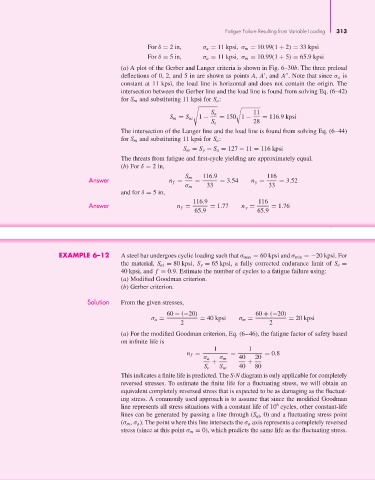
                                               (a) A plot of the Gerber and Langer criteria is shown in Fig. 6–30b. The three preload


                                               deflections of 0, 2, and 5 in are shown as points A,  A , and  A . Note that since σ a is
                                               constant at 11 kpsi, the load line is horizontal and does not contain the origin. The
                                               intersection between the Gerber line and the load line is found from solving Eq. (6–42)
                                               for S m and substituting 11 kpsi for S a :


                                                                           S a          11
                                                              S m = S ut 1 −  = 150 1 −   = 116.9 kpsi
                                                                           S e          28
                                               The intersection of the Langer line and the load line is found from solving Eq. (6–44)
                                               for S m and substituting 11 kpsi for S a :
                                                                  S m = S y − S a = 127 − 11 = 116 kpsi
                                               The threats from fatigue and first-cycle yielding are approximately equal.
                                               (b) For δ = 2 in,

                                     Answer                   n f =  S m  =  116.9  = 3.54  n y =  116  = 3.52
                                                                   σ m   33                 33
                                               and for δ = 5 in,
                                                                     116.9               116
                                     Answer                     n f =     = 1.77    n y =    = 1.76
                                                                     65.9                65.9


                            EXAMPLE 6–12       A steel bar undergoes cyclic loading such that σ max = 60 kpsi and σ min =−20 kpsi. For
                                               the material,  S ut = 80 kpsi,  S y = 65 kpsi, a fully corrected endurance limit of  S e =
                                               40 kpsi, and  f = 0.9. Estimate the number of cycles to a fatigue failure using:
                                               (a) Modified Goodman criterion.
                                               (b) Gerber criterion.

                                    Solution   From the given stresses,

                                                             60 − (−20)                 60 + (−20)
                                                        σ a =          = 40 kpsi   σ m =           = 20 kpsi
                                                                 2                          2
                                               (a) For the modified Goodman criterion, Eq. (6–46), the fatigue factor of safety based
                                               on infinite life is
                                                                           1          1
                                                                   n f =         =         = 0.8
                                                                        σ a  σ m   40   20
                                                                           +          +
                                                                        S e  S ut  40   80
                                               This indicates a finite life is predicted. The S-N diagram is only applicable for completely
                                               reversed stresses. To estimate the finite life for a fluctuating stress, we will obtain an
                                               equivalent completely reversed stress that is expected to be as damaging as the fluctuat-
                                               ing stress. A commonly used approach is to assume that since the modified Goodman
                                                                                               6
                                               line represents all stress situations with a constant life of 10 cycles, other constant-life
                                               lines can be generated by passing a line through (S ut , 0) and a fluctuating stress point
                                               (σ m , σ a ). The point where this line intersects the σ a axis represents a completely reversed
                                               stress (since at this point σ m = 0), which predicts the same life as the fluctuating stress.

