


Page 339 - Shigley's Mechanical Engineering Design
P. 339
bud29281_ch06_265-357.qxd  12/02/2009  6:49 pm  Page 314 pinnacle s-171:Desktop Folder:Temp Work:Don't Delete (Jobs):MHDQ196/Budynas:


                 314   Mechanical Engineering Design
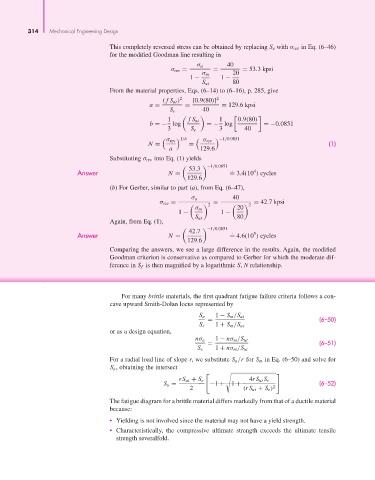
                                          This completely reversed stress can be obtained by replacing S e with σ rev in Eq. (6–46)
                                          for the modified Goodman line resulting in
                                                                     σ a      40
                                                             σ rev =      =        = 53.3 kpsi
                                                                      σ m       20
                                                                   1 −      1 −
                                                                      S ut      80
                                          From the material properties, Eqs. (6–14) to (6–16), p. 285, give
                                                          ( fS ut ) 2  [0.9(80)] 2
                                                      a =        =          = 129.6 kpsi
                                                             S e       40
                                                            1      fS ut  	  1    0.9(80)
                                                      b =− log          =− log           =−0.0851
                                                            3      S e      3       40
                                                                1/b         −1/0.0851
                                                           σ rev       σ rev

                                                      N =         =                                           (1)
                                                            a         129.6
                                          Substituting σ rev into Eq. (1) yields
                                                                   53.3  	 −1/0.0851
                                                                               .
                                                                                      4
                                Answer                      N =                = 3.4(10 ) cycles
                                                                  129.6
                                          (b) For Gerber, similar to part (a), from Eq. (6–47),
                                                                                40
                                                                   σ a
                                                         σ rev =       	 =         	 = 42.7 kpsi
                                                                        2            2
                                                                    σ m          20
                                                               1 −          1 −
                                                                    S ut         80
                                          Again, from Eq. (1),
                                                                   42.7  	 −1/0.0851
                                                                               .
                                Answer                      N =                = 4.6(10 ) cycles
                                                                                      5
                                                                  129.6
                                          Comparing the answers, we see a large difference in the results. Again, the modified
                                          Goodman criterion is conservative as compared to Gerber for which the moderate dif-
                                          ference in S f is then magnified by a logarithmic S, N relationship.

                                              For many brittle materials, the first quadrant fatigue failure criteria follows a con-
                                          cave upward Smith-Dolan locus represented by
                                                                      S a  1 − S m /S ut
                                                                        =                                  (6–50)
                                                                      S e  1 + S m /S ut
                                          or as a design equation,
                                                                    nσ a   1 − nσ m /S ut
                                                                        =                                  (6–51)
                                                                     S e   1 + nσ m /S ut
                                          For a radial load line of slope r, we substitute S a /r for S m in Eq. (6–50) and solve for
                                          S a , obtaining the intersect


                                                               rS ut + S e           4rS ut S e
                                                           S a =         −1 +  1 +          2              (6–52)
                                                                   2               (rS ut + S e )
                                          The fatigue diagram for a brittle material differs markedly from that of a ductile material
                                          because:
                                          • Yielding is not involved since the material may not have a yield strength.
                                          • Characteristically, the compressive ultimate strength exceeds the ultimate tensile
                                            strength severalfold.

