


Page 456 - Shigley's Mechanical Engineering Design
P. 456
bud29281_ch08_409-474.qxd  12/22/09  5:45 PM  Page 431 epg Disk1:Desktop Folder:TEMPWORK:Don't-Delete Jobs:MHDQ196/Budynas:


                                                                       Screws, Fasteners, and the Design of Nonpermanent Joints  431
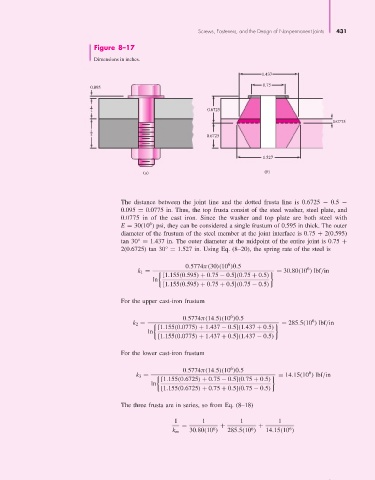
                                       Figure 8–17

                                       Dimensions in inches.

                                                                                          1.437
                                                                                           0.75
                                     0.095

                                     1
                                     2                                   0.6725
                                                                                                                0.0775
                                      3
                                      4                                  0.6725


                                                                                          1.527

                                                      (a)                                  (b)


                                               The distance between the joint line and the dotted frusta line is 0.6725  − 0.5  −
                                               0.095 = 0.0775 in. Thus, the top frusta consist of the steel washer, steel plate, and
                                               0.0775 in of the cast iron. Since the washer and top plate are both steel with
                                                        6
                                               E = 30(10 ) psi, they can be considered a single frustum of 0.595 in thick. The outer
                                               diameter of the frustum of the steel member at the joint interface is 0.75 + 2(0.595)
                                               tan 30° = 1.437 in. The outer diameter at the midpoint of the entire joint is 0.75 +
                                               2(0.6725) tan 30° = 1.527 in. Using Eq. (8–20), the spring rate of the steel is

                                                                                6
                                                                   0.5774π(30)(10 )0.5                  6
                                                    k 1 =                                      = 30.80(10 ) lbf/in
                                                            [1.155(0.595) + 0.75 − 0.5](0.75 + 0.5)
                                                         ln
                                                            [1.155(0.595) + 0.75 + 0.5](0.75 − 0.5)
                                               For the upper cast-iron frustum

                                                                                 6
                                                                  0.5774π(14.5)(10 )0.5                   6
                                                  k 2 =                                         = 285.5(10 ) lbf/in
                                                          [1.155(0.0775) + 1.437 − 0.5](1.437 + 0.5)
                                                       ln
                                                          [1.155(0.0775) + 1.437 + 0.5](1.437 − 0.5)
                                               For the lower cast-iron frustum

                                                                                 6
                                                                  0.5774π(14.5)(10 )0.5                  6
                                                   k 3 =                                       = 14.15(10 ) lbf/in
                                                           [1.155(0.6725) + 0.75 − 0.5](0.75 + 0.5)
                                                        ln
                                                           [1.155(0.6725) + 0.75 + 0.5](0.75 − 0.5)
                                               The three frusta are in series, so from Eq. (8–18)

                                                               1        1           1          1
                                                                  =          +           +
                                                                                                   6
                                                                           6
                                                                                       6
                                                               k m  30.80(10 )  285.5(10 )  14.15(10 )

