


Page 419 -
P. 419
422                                                      M. Neumann

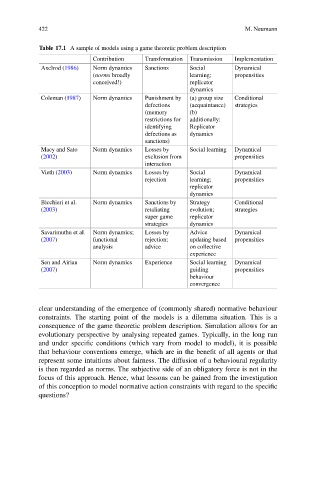
            Table 17.1 A sample of models using a game theoretic problem description
                           Contribution  Transformation  Transmission  Implementation
            Axelrod (1986)  Norm dynamics  Sanctions  Social      Dynamical
                           (norms broadly             learning;   propensities
                           conceived!)                replicator
                                                      dynamics
            Coleman (1987)  Norm dynamics  Punishment by  (a) group size  Conditional
                                         defections   (acquaintance)  strategies
                                         (memory      (b)
                                         restrictions for  additionally:
                                         identifying  Replicator
                                         defections as  dynamics
                                         sanctions)
            Macy and Sato  Norm dynamics  Losses by   Social learning  Dynamical
            (2002)                       exclusion from           propensities
                                         interaction
            Vieth (2003)   Norm dynamics  Losses by   Social      Dynamical
                                         rejection    learning;   propensities
                                                      replicator
                                                      dynamics
            Bicchieri et al.  Norm dynamics  Sanctions by  Strategy  Conditional
            (2003)                       retaliating  evolution;  strategies
                                         super game   replicator
                                         strategies   dynamics
            Savarimuthu et al.  Norm dynamics;  Losses by  Advice  Dynamical
            (2007)         functional    rejection;   updating based  propensities
                           analysis      advice       on collective
                                                      experience
            Sen and Airiau  Norm dynamics  Experience  Social learning  Dynamical
            (2007)                                    guiding     propensities
                                                      behaviour
                                                      convergence


            clear understanding of the emergence of (commonly shared) normative behaviour
            constraints. The starting point of the models is a dilemma situation. This is a
            consequence of the game theoretic problem description. Simulation allows for an
            evolutionary perspective by analysing repeated games. Typically, in the long run
            and under specific conditions (which vary from model to model), it is possible
            that behaviour conventions emerge, which are in the benefit of all agents or that
            represent some intuitions about fairness. The diffusion of a behavioural regularity
            is then regarded as norms. The subjective side of an obligatory force is not in the
            focus of this approach. Hence, what lessons can be gained from the investigation
            of this conception to model normative action constraints with regard to the specific
            questions?

