


Page 423 -
P. 423
426                                                      M. Neumann

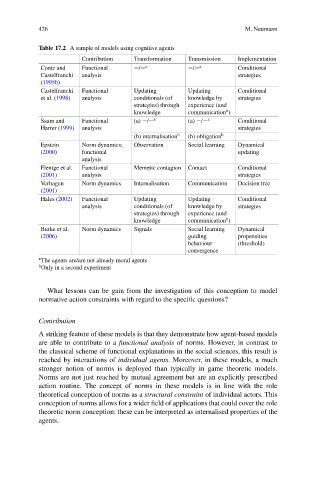
            Table 17.2 A sample of models using cognitive agents
                        Contribution  Transformation  Transmission  Implementation
            Conte and   Functional     /  a           /  a         Conditional
            Castelfranchi  analysis                                strategies
            (1995b)
            Castelfranchi  Functional  Updating      Updating      Conditional
            et al. (1998)  analysis   conditionals (of  knowledge by  strategies
                                      strategies) through  experience (and
                                                                b
                                      knowledge      communication )
            Saam and    Functional    (a)  /  a      (a)  /  a     Conditional
            Harrer (1999)  analysis                                strategies
                                      (b) internalisation b  (b) obligation b
            Epstein     Norm dynamics;  Observation  Social learning  Dynamical
            (2000)      functional                                 updating
                        analysis
            Flentge et al.  Functional  Memetic contagion  Contact  Conditional
            (2001)      analysis                                   strategies
            Verhagen    Norm dynamics  Internalisation  Communication  Decision tree
            (2001)
            Hales (2002)  Functional  Updating       Updating      Conditional
                        analysis      conditionals (of  knowledge by  strategies
                                      strategies) through  experience (and
                                                                b
                                      knowledge      communication )
            Burke et al.  Norm dynamics  Signals     Social learning  Dynamical
            (2006)                                   guiding       propensities
                                                     behaviour     (threshold)
                                                     convergence
            a The agents are/are not already moral agents
            b Only in a second experiment


              What lessons can be gain from the investigation of this conception to model
            normative action constraints with regard to the specific questions?

            Contribution
            A striking feature of these models is that they demonstrate how agent-based models
            are able to contribute to a functional analysis of norms. However, in contrast to
            the classical scheme of functional explanations in the social sciences, this result is
            reached by interactions of individual agents. Moreover, in these models, a much
            stronger notion of norms is deployed than typically in game theoretic models.
            Norms are not just reached by mutual agreement but are an explicitly prescribed
            action routine. The concept of norms in these models is in line with the role
            theoretical conception of norms as a structural constraint of individual actors. This
            conception of norms allows for a wider field of applications that could cover the role
            theoretic norm conception: these can be interpreted as internalised properties of the
            agents.

