


Page 102 - Social Marketing for Public Health Global Trends and Success Stories
P. 102
57977_CH03_final.qxd:Cheng  11/6/09  11:34 AM  Page 75


                                                                                     Strategies    75


                           • Address the disconnection between perceived physical activity levels
                             and real physical activity levels.
                           • Encourage parents to pay attention to how much activity their kids are
                             really getting.

                        The communication channels used include mass media (television, radio,
                     newspapers, outdoor, movie theaters, and posters), schools, workplaces, public
                     events, prompts in public settings, and the Internet. Messengers are peers (testi-
                     monials), actors to whom individuals can relate, and ambassadors (influential in-
                     dividuals from a variety of settings).
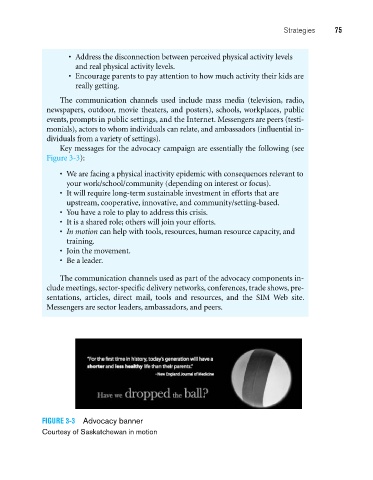
                        Key messages for the advocacy campaign are essentially the following (see
                     Figure 3-3):
                        • We are facing a physical inactivity epidemic with consequences relevant to
                          your work/school/community (depending on interest or focus).
                        • It will require long-term sustainable investment in efforts that are
                          upstream, cooperative, innovative, and community/setting-based.
                        • You have a role to play to address this crisis.
                        • It is a shared role; others will join your efforts.
                        • In motion can help with tools, resources, human resource capacity, and
                          training.
                        • Join the movement.
                        • Be a leader.

                        The communication channels used as part of the advocacy components in-
                     clude meetings, sector-specific delivery networks, conferences, trade shows, pre-
                     sentations, articles, direct mail, tools and resources, and the SIM  Web site.
                     Messengers are sector leaders, ambassadors, and peers.


                    FIGURE 3-3 Advocacy banner
                    Courtesy of Saskatchewan in motion

