


Page 202 - Standard Handbook Of Petroleum & Natural Gas Engineering
P. 202
Strength of Materials   187


                      stress is called the ultimate tensile strength, UTS, of the material. Standard engineering
                      practice is to define the yield point as 0.2% permanent strain.
                        When a bar is elongated  axially, as in Figure 2-25, it will contract laterally. The
                      negative ratio of the lateral strain to the axial strain is called Poisson's  ratio v. For
                      isotropic  materials, materials that have the same elastic properties in all directions,
                      Poisson's ratio has a value of about 0.3.
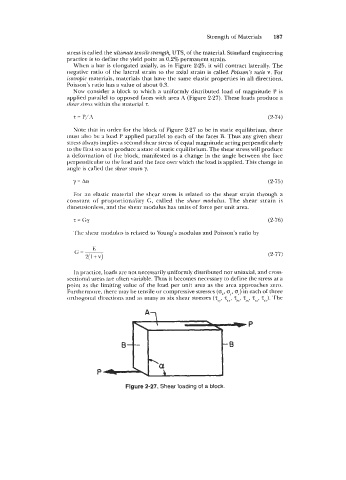
                        Now  consider  a block  to which a uniformly  distributed load of  magnitude P  is
                      applied parallel to opposed faces with area A (Figure 2-27). These loads produce a
                      shear stress within the material T.
                        T = P/A                                                     (2-74)
                        Note that in order for the block of Figure 2-27 to be in static equilibrium, there
                      must also be a load P applied parallel to each of the faces B. Thus any given shear
                      stress always implies a second shear stress of equal magnitude acting perpendicularly
                      to the first so as to produce a state of static equilibrium. The shear stress will produce
                      a deformation of  the block, manifested  as a change in the angle between  the face
                      perpendicular to the load and the face over which the load is applied. This change in
                      angle is called the shear strain y.
                        y= Aa                                                       (2-75)

                        For  an  elastic material  the  shear  stress is  related  to the shear  strain  through a
                      constant of  proportionality  G, called  the  shear  modulus.  The shear strain  is
                      dimensionless, and the shear modulus has units of force per unit area.

                        T = c;y                                                     (2-76)
                        The shear modulus is related to Young's modulus and Poisson's ratio by


                        G=-   E
                           2( 1 + v)                                                (2-77)

                        In practice, loads are not necessarily uniformly distributed nor uniaxial, and cross-
                      sec~ional areas are often variable. Thus it becomes necessary to define the stress at a
                      point  ab the limiting value of  the load per unit area as the area approaches zero.
                      Furthermore, there may be tensile or compressive stresses (ox, oY, 0,) in each of three
                      orthogonal directions and as many as six shear stresses (T~", T~~, T~,, T,~, zyL, TJ.  The


                               P

                                        Figure 2-27. Shear loading of a block.

