


Page 201 - Standard Handbook Of Petroleum & Natural Gas Engineering
P. 201
186    General Engineering and Science


                                P


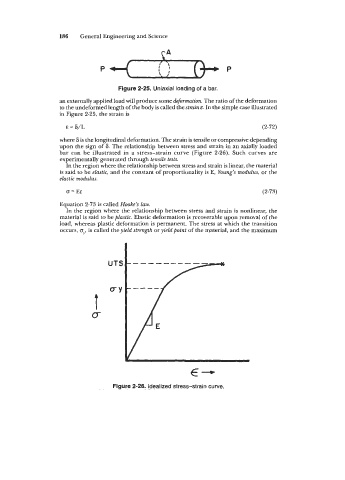
                                     Figure 2-25. Uniaxial loading of a bar.

                   an externally applied load will produce some deformation. The ratio of the deformation
                   to the undeformed length of the body is called the strain E. In the simple case illustrated
                   in Figure 2-25, the strain is

                     E = 6/L                                                      (2-72)
                   where 6 is the longitudinal deformation. The strain is tensile or compressive depending
                   upon the sign of 6. The relationship between stress and strain in an axially loaded
                   bar  can  be  illustrated  in  a  stress-strain  curve  (Figure 2-26).  Such  curves  are
                   experimentally generated through tensile tests.
                     In the region where the relationship between stress and strain is linear, the material
                   is said to be elastic, and the constant of proportionality  is E, Young's modulus, or the
                   elastic modulus.
                     (T = E&                                                      (2-73)
                   Equation 2-73 is called Hooke's law.
                     In the region where the relationship between stress and strain is nonlinear, the
                   material is said to be plastic. Elastic deformation is recoverable upon removal of the
                   load, whereas plastic deformation is permanent.  The stress at which the transition
                   occurs, (T",  is called the yield strength or yield point of the material, and the maximum


                                  UTS


                                   CY
                              t

                             cr


                                                            €-

                                    Figure 2-26. Idealized stress-strain  curve.

