


Page 205 - Standard Handbook Of Petroleum & Natural Gas Engineering
P. 205
190    General Engineering and Science

                     Transverse Loading of Beams
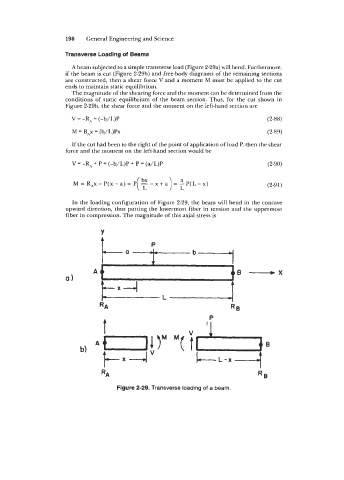
                       A beam subjected to a simple transverse load (Figure 2-29a) will bend. Furthermore,
                     if the beam is cut (Figure 2-2913) and free-body diagrams of the remaining sections
                     are constructed, then a shear force V and a moment  M must be applied to the cut
                     ends to maintain static equilibrium.
                       The magnitude of the shearing force and the moment can be determined from the
                     conditions  of  static equilibrium  of  the  beam  section. Thus, for  the cut  shown in
                     Figure 2-29b, the shear force and the moment on the left-hand section are
                       V = -RA = (-b/L)P                                           (2-88)

                       M = RAx = (b/L)Px                                           (2-89)
                       If the cut had been to the right of the point of application of load P, then the shear
                     force and the moment on the left-hand section would be

                       V = -R,  + P = (-b/L)P  + P = (a/L)P                         (2-90)


                                                                                   (2-91)

                       In  the loading configuration of Figure 2-29, the beam will bend in the concave
                     upward  direction, thus putting the lowermost fiber in tension  and the uppermost
                     fiber in compression. The magnitude of this axial stress is

                                Y
                                                P


                                RA                                      RR

                                 t


                                RA

                                     Figure 2-29. Transverse loading of a beam.

