


Page 203 - Standard Handbook Of Petroleum & Natural Gas Engineering
P. 203
188   General Engineering and Science


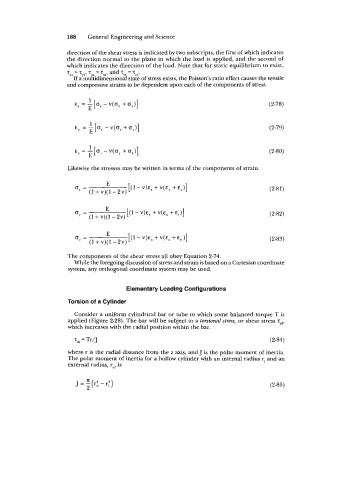
                      direction of the shear stress is indicated by  two subscripts, the first of which indicates
                      the direction normal to the plane in which the load is applied, and the second of
                     which indicates the direction of the load. Note that for static equilibrium to exist,
                     zxy = zyx, zu = z=,  and zYz = T~~.
                        If a multidimensional state of stress exists, the Poisson’s ratio effect causes the tensile
                      and compressive strains to be dependent upon each of the components of stress.

                            1
                        E,  = -[ox  - V(OY +o,)]                                    (2-78)
                            E
                             1
                            E
                        E,  = -[oy - v(0, + (T,)]                                   (2-79)

                            1
                        E,  = -[oz - v(0, + (T,)]                                   (2-80)
                            E
                      Likewise the stresses may be written in terms of the components of strain.


                                                                                    (2-81)


                        (T=      E      ((1 - V)E,  + V(E,  + 4                     (2-82)
                            (1 + v)(l- 2v)
                                  E
                        (T=             [ (1 - V)E,  + V(E,  + E,  )]               (2-83)
                            (1 + v)(l- 2v)
                      The components of the shear stress all obey Equation 2-74.
                        While the foregoing discussion of stress and strain is based on a Cartesian coordinate
                      system, any orthogonal coordinate system may be used.


                                        Elementary Loading Configurations
                      Torsion of a Cylinder

                        Consider a uniform cylindrical bar or tube to which some balanced torque T is
                      applied (Figure 2-28). The bar will be subject to a torsional stress, or shear stress z,,
                      which increases with the radial position within the bar.

                        zze = Tr/J                                                  (2-84)
                      where r is the radial distance from the z axis, and J is the polar moment of inertia.
                      The polar moment of inertia for a hollow cylinder with an internal radius ri and an
                      external radius, ro, is

                           R
                        J = -(r:  - r:  1                                           (2-85)
                           2

