


Page 200 - Standard Handbook Of Petroleum & Natural Gas Engineering
P. 200
Strength of Materials   185


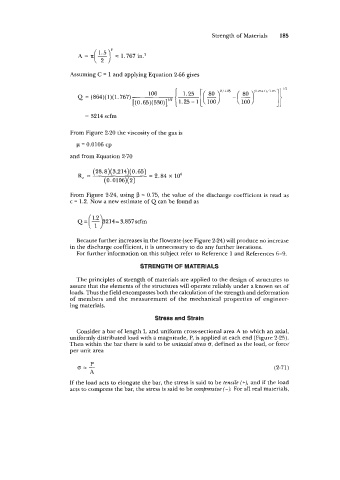
                         A  = n(    = 1.767 in.'


                      Assuming C = 1 and applying Equation 2-66 gives


                         Q = (864)(1)(1.767)


                           = 3214 scfm

                      From Figure 2-20 the viscosity of the gas is
                          = 0.0106 cp
                      and from Equation 2-70

                             (28.8)( 3,2 14) (0.65)
                         R,  =                 = 2.84 x lo6
                                 (0.0106)(2)
                      From Figure 2-24, using p = 0.75, the value of  the discharge coefficient is  read as
                      c = 1.2. Now a new estimate of Q can be found as
                            (3
                         Q=  - 3214=3,857scfm

                        Because further increases in the flowrate (see Figure 2-24) will produce no increase
                      in the discharge coefficient, it is unnecessary to do any further iterations.
                        For further information on this subject refer to Reference 1 and References 6-9.
                                            STRENGTH OF MATERIALS

                        The principles of strength of materials are applied to the design of  structures to
                      assure that the elements of the structures will operate reliably under a known set of
                      loads. Thus the field encompasses both the calculation of the strength and deformation
                      of  members  and  the  measurement  of  the  mechanical  properties of  engineer-
                      ing materials.
                                                Stress and Strain
                         Consider a bar of  length L and uniform cross-sectional area A to which an axial,
                      uniformly distributed load with a magnitude, P, is applied at each end (Figure 2-25).
                      Then within the bar there is said to be uniaxial stress c, defined as the load, or force
                      per unit area

                             P
                         (3=-                                                        (2-71)
                             A
                      If the load acts to elongate the bar, the stress is said to be tensile (+), and if the load
                      acts to compress the bar, the stress is said to be compressive (-). For all real materials,

