


Page 198 - Standard Handbook Of Petroleum & Natural Gas Engineering
P. 198
Fluid Mechanics   183

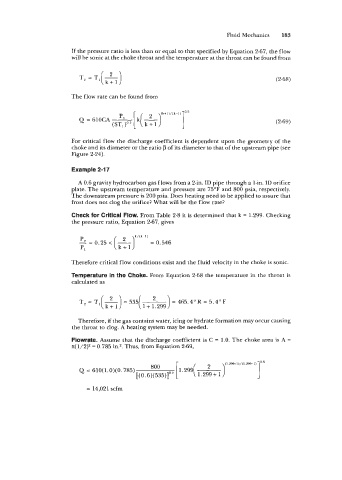
                       If the pressure ratio is less than or equal to that specified by  Equation 2-67, the flow
                       will be sonic at the choke throat and the temperature at the throat can be found from

                         T2  = TI( &)                                                (2-68)


                       The flow rate can be found from


                                                                                     (2-69)


                       For critical flow the discharge coefficient is dependent upon  the geometry of  the
                       choke and its diameter or the ratio p of its diameter to that of the upstream pipe (see
                       Figure 2-24).

                       Example 2-1 7
                         A 0.6 gravity hydrocarbon gas flows from a 2-in. ID pipe through a 1-in. ID orifice
                       plate. The upstream temperature  and pressure are 75°F and 800 psia, respectively.
                       The downstream pressure is 200 psia. Does heating need to be applied to assure that
                       frost does not clog the orifice? What will be the flow rate?
                       Check for Critical Flow. From Table 2-8 it is determined that k = 1.299. Checking
                       the pressure ratio, Equation 2-67, gives
                         -- - 0.25 < (-)  2   k'(k-l)   = 0.546
                         "
                          PI         k+l

                       Therefore critical flow conditions exist and the fluid velocity in the choke is sonic.

                       Temperature in the Choke. From Equation 2-68 the temperature in the throat is
                       calculated as


                         T,  = TI(-&-)   = 535(     ) = 465.4"R =5.4"F
                                             1 + 1.299
                         Therefore, if the gas contains water, icing or hydrate formation may occur causing
                       the throat to clog. A heating system may be needed.
                       Flowrate. Assume that the discharge coefficient is C = 1.0. The choke area is A  =
                       R( 1/2),  = 0.785 in?. Thus, from Equation 2-69,


                                                                      (1.299t1)/(1.29%1)   0.5
                                               800                             3
                         Q = 610(1.0)(0.785)
                                                       [1.2gg( 1.299+1)
                                           [( 0. 6)(535)]0'5
                           = 14.021 scfm

