


Page 196 - Standard Handbook Of Petroleum & Natural Gas Engineering
P. 196
Fluid Mechanics   181

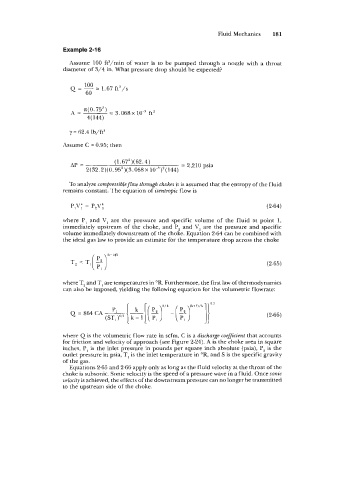
                    Example 2-1 6
                      Assume  100 ft3/min  of  water  is  to be pumped  through a nozzle with  a  throat
                    diameter of 3/4  in. What pressure drop should be expected?

                           100
                              =
                       Q = - 1.67 ftg/s
                           60


                      y = 62.4 lb/ft3

                    Assume C = 0.95; then

                                    (1.67*)( 62.4)
                       AP  =                            = 2,210 psia
                           2( 32.2)(0.95*)( 3.068 x lo-')*( 144)
                      To analyze compressible flow through chokes it is assumed that the entropy of the fluid
                    remains constant. The equation of isentropic flow is

                       p,v;  = P,Vi                                               (2-64)
                    where PI and VI are  the pressure and specific  volume  of  the  fluid  at point  1,
                    immediately upstream  of  the choke, and P,  and V,  are the pressure  and specific
                    volume immediately downstream of the choke. Equation 2-64 can be combined with
                    the ideal gas law to provide an estimate for the temperature drop across the choke
                             (  rlii

                       T, =T, 2                                                   (2-65)


                    where T, and T, are temperatures in OR. Furthermore, the first law of thermodynamics
                    can also be imposed, yielding the following equation for the volumetric flowrate:


                                                                                  (2-66)


                    where Q is the volumetric flow rate in scfm, C is a discharge coefficient  that accounts
                    for friction and velocity of approach (see Figure 2-24). A is the choke area in square
                    inches, PI is the inlet pressure in pounds per square inch absolute (psia), P,  is the
                    outlet pressure in psia, TI is the inlet temperature in OR, and S is the specific gravity
                    of the gas.
                      Equations 2-65 and 2-66 apply only as long as the fluid velocity at the throat of the
                    choke is subsonic. Sonic velocity is the speed of a pressure wave in a fluid. Once  sonic
                    velocity is achieved, the effects of the downstream pressure can no longer be transmitted
                    to the upstream side of the choke.

