


Page 192 - Standard Handbook Of Petroleum & Natural Gas Engineering
P. 192
Fluid Mechanics   177

                    At  104°F


                    Because R > 4,000 the flow is turbulent. From Table 2-9, E = 150 x   and E/D = 0.0018.
                    Interpolating from Figure 2-21 yields f = 0.03. Now apply the Colebrook equation:

                                  I
                        1
                       - -2lOg,"  -
                          =
                                   0.0018 +
                       fi            3.7   (18,150)(0.03)"
                      f = 0.02991
                                                       2( 32.2)(0.0833)  I
                                                    (0.02991)(100)(80.21)2 = 610 psi
                       P,  = 2,000+(~)[(l;0-100)-

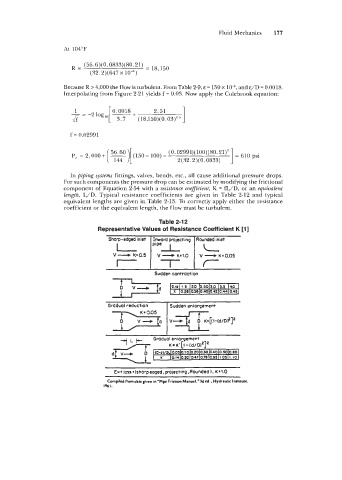
                      In pzping system fittings, valves, bends, etc., all cause additional pressure drops.
                    For such components the pressure drop can be estimated by modifying the frictional
                    component of Equation 2-54 with a resistance coefficient,  K = fL/D,  or an equivalent
                    length,  L/D.  Typical  resistance  coefficients are  given  in Table  2-12 and  typical
                    equivalent lengths are given in Table 2-13. To correctly apply either the resistance
                    coefficient or the equivalent length, the flow must be turbulent.

                                                 Table 2-12
                               Representative Values of Resistance Coefficient K [l]


                                   -            Sudden contraction


                                  Grodual reduction   Sudden enlargement


                                                Gradual enlargement
                                                    K  K'[1  -(d/Dlz]'
                                                (D-dVSLI  0.05l0.10 lO.ZOlOWb.40 lO.5010.80
                                   d     B     1  K'  lo.irlo.zolo.~rlo.~Io.9sIi os[t.to
                                    Exit loss=(sharpeoged,pojcctinp.Rounded 1, K.1.0
                                 Compiled from datagivcn in"Pip Friction Manunl.'idrd..  Hydriulic instirutc.
                                1961.

