


Page 188 - Standard Handbook Of Petroleum & Natural Gas Engineering
P. 188
Fluid Mechanics   173


                                                                                   (2-57)


                                                                                   (2-58)

                         = 7, + P( %)                                              (2-59)


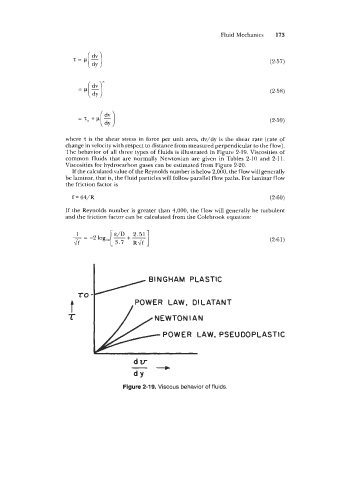
                     where  T is  the shear stress in force per unit area, dv/dy  is  the shear rate (rate of
                     change in velocity with respect to distance from measured perpendicular  to the flow).
                     The behavior of all three types of fluids is illustrated in Figure 2-19. Viscosities of
                     common fluids that  are  normally  Newtonian  are given  in Tables  2-10 and 2-11.
                     Viscosities for hydrocarbon gases can be estimated from Figure 2-20.
                       If the calculated value of the Reynolds number is below 2,000, the flow will generally
                     be laminar, that is, the fluid particles will follow parallel flow paths. For laminar flow
                     the friction factor is

                       f = 64/R                                                    (2-60)
                     If  the Reynolds number is greater than 4,000, the flow will generally be turbulent
                     and the friction factor can be calculated from the Colebrook equation:

                        1
                       - -2  log,,,[                                               (2-61)
                          =
                       &                + "1  R&


                                              BINGHAM  PLASTIC
                         TO -
                      t                   POWER  LAW,  DILATANT

                      It                        NEWTONIAN


                                                  POWER  LAW, PSEUDOPLASTIC


                                         -
                                         dV
                                                *
                                         dY
                                      Figure 2-19. Viscous behavior of fluids.

