


Page 183 - Standard Handbook Of Petroleum & Natural Gas Engineering
P. 183
168   General Engineering and Science


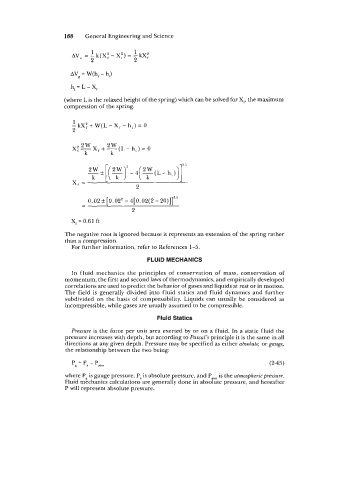
                       AVp = W( h, - hi)

                       h, = L - X,
                     (where L is the relaxed height of the spring) which can be solved for X,  the maximum
                     compression of the spring.
                       1
                       2
                       -kX:  + W(L- X, -hi) = 0

                          2w      2w
                       X:-Xx,   +-(L-    h,) = 0
                           k       k


                          - 0.02+[0.02* - 4[0.02(2-20)]]0'5
                          -
                                         2
                       X, = 0.61 ft

                     The negative root is ignored because it represents an extension of the spring rather
                     than a compression.
                       For further information, refer to References 1-5.

                                              FLUID MECHANICS
                       In  fluid mechanics the principles  of  conservation of  mass,  conservation of
                     momentum, the first and second laws of thermodynamics, and empirically developed
                     correlations are used to predict the behavior of gases and liquids at rest or in motion.
                     The field  is  generally  divided  into fluid statics and fluid dynamics  and further
                     subdivided  on  the basis of  compressibility. Liquids  can  usually be considered  as
                     incompressible, while gases are usually assumed to be compressible.
                                                 Fluid Statics
                       Pressure is the force per unit area exerted by or on a fluid. In a static fluid the
                     pressure increases with depth, but according to Pascal's principle it is the same in all
                     directions at any given depth. Pressure may be specified as either absolute, or gauge,
                     the relationship between the two being:


                     where Pp  is gauge pressure, Pa is absolute pressure, and Patm is the atmospheric pressure.
                     Fluid mechanics calculations are generally done in absolute pressure, and hereafter
                     P will represent absolute pressure.

