


Page 181 - Standard Handbook Of Petroleum & Natural Gas Engineering
P. 181
166   General Engineering and Science

                    where  V is  the velocity of the center of  mass and d is  the perpendicular distance
                    between the vector v and the point 0. And if 0 is a fixed axis or instantaneous center
                    of zero velocity, then

                       H, = I,o                                                    (2-37)
                       Likewise, the angular impulse is defined as

                       I M,dt  = AH,,                                              (2-38)

                     In collisions, angular momentum, like linear momentum, is conserved.

                     Conservation of Energy
                       In a rigid-body system, energy is  conserved in the sense that  the net change in
                     mechanical energy must be equal to the net work done on the system.

                       U = AT + AVg + AVe                                          (2-39)
                       U is the net work done on the system and is defined as the sum of the work done
                     by external forces and external moments.

                       U  =jF*ds+jM*dB                                             (2-40)

                     The work of the force F is positive if it acts in the direction of the displacement ds,
                     and the work of the moment M is positive if it acts in the direction of rotation de.
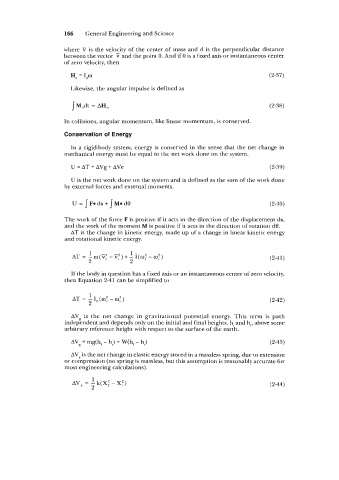
                       AT  is the change in kinetic energy, made up of a change in linear kinetic energy
                     and rotational kinetic energy.

                            1            1-
                       AT  = -m(C:-Vy)+-I(mt-of)
                            2            2
                       If the body in question has a fixed axis or an instantaneous center of zero velocity,
                     then Equation 2-41 can be simplified to


                       AVg is  the  net  change in gravitational  potential  energy. This  term  is  path
                     independent and depends only on the initial and final heights, h, and h,  above some
                     arbitrary reference height with respect to the surface of the earth.
                       AVg = mg(h, - hi) = W(h, - h,)                              (2-43)
                       AVe is the net change in elastic energy stored in a massless spring, due to extension
                     or compression (no spring is massless, but this assumption is reasonably accurate for
                     most engineering calculations).
                             1
                       AVe = - k(X; - Xy)                                          (2-44)
                             2

