


Page 185 - Standard Handbook Of Petroleum & Natural Gas Engineering
P. 185
170   General Engineering and Science

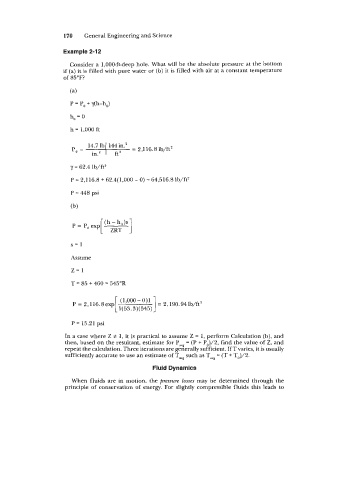
                    Example 2-12

                      Consider a 1,000-ft-deep hole. What will be the absolute pressure at the bottom
                    if  (a) it is filled with pure water or (b) it is filled with air at a constant temperature
                    of 85"F?

                      (a)
                      P = P,  + dh-h,)

                       h,  = 0
                      h = 1,000 ft


                       y = 62.4 lb/ft3

                       P = 2,116.8 + 62.4(1,000 - 0) = 64,516.8 lb/ft2
                       P = 448 psi

                       (b)


                       s=l
                       Assume

                       z=l
                       T = 85 + 460 = 545"R
                                     1( 53.3)( 545) 1
                       P = 2,116.8exp   (1'000-0)1   = 2,190.941b/ft2


                       P = 15.21 psi
                     In a case where Z  # 1, it is practical to assume Z  = 1, perform Calculation (b), and
                     then, based on the resultant, estimate for Pavg = (P + P,)/2,  find the value of Z, and
                     repeat the calculation. Three iterations are generally sufficient. If T varies, it is usually
                     sufficiently accurate to use an estimate of Tavg such as Tavg = (T + TJ2.
                                                Fluid Dynamics

                       When  fluids are in  motion,  the pressure  losses may  be  determined  through  the
                     principle  of  conservation of  energy. For  slightly compressible fluids  this leads to

