


Page 182 - Standard Handbook Of Petroleum & Natural Gas Engineering
P. 182
Dynamics   167

                   The constant k, called the spring constant, represents the ratio of the force exerted
                   by the spring to X, its net compression or extension from the rest length.

                    Example 2-11
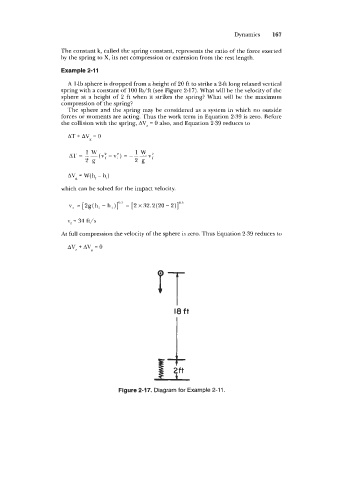
                      A 1-lb sphere is dropped from a height of 20 ft to strike a 2-ft long relaxed vertical
                    spring with a constant of  100 lb/ft  (see Figure 2-17). What will be the velocity of the
                    sphere at a height  of  2  ft when  it strikes  the spring? What will  be the maximum
                    compression of the spring?
                     The sphere and the spring may  be considered as a system in which no outside
                    forces or moments are acting. Thus the work term in Equation  2-39 is zero. Before
                    the collision with the spring, AVe = 0 also, and Equation  2-39 reduces to
                      AT + AVp = 0


                      AVp  = W(h, - hi)

                    which can be solved for the impact velocity.


                      Vf  = 34 ft/s

                    At full compression the velocity of the sphere is zero. Thus Equation 2-39 reduces to
                      AV? + AVg = 0


                                                      I8 ft


                                     Figure 2-17. Diagram for Example 2-11.

