


Page 186 - Standard Handbook Of Petroleum & Natural Gas Engineering
P. 186
Fluid Mechanics   171

                     Rrrnoulli 'F  equation (Equation 2-53), which accounts for static and dynarnzc. pressure
                     loswr (due to changes in velocity), but does not account for frictional pressure losseu,
                     energv losses due to heat transfer, or work done in an engine.


                                                                                   (2-53)

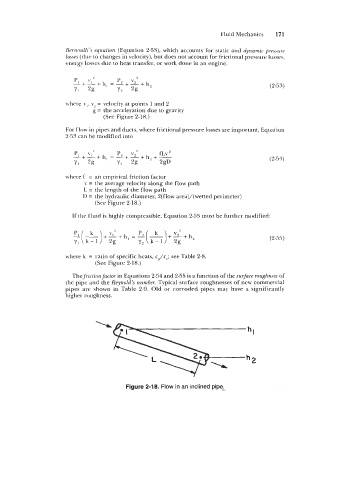
                     where v,, v2 = velocity at points  1 and 2
                             g = the acceleration due to gravity
                                (See Figure 2-18.)
                     For flow in pipes and ducts, where frictional pressure losses are important, Equation
                     2-53 can he modified into


                                                                                   (2-54)

                     where f  E  an empirical friction factor
                           v = the average velocity along the flow path
                          L = the length of the flow path
                          D E  the hydraulic diameter, 2(flow area)/(wetted  perimeter)
                              (See Figure 2-18.)
                       If the fluid is highly compressible, Equation 2-53 must be further modified:


                                                                                   (2-55)

                     where k  = ratio of specific heats, cdc,; see Table 2-8.
                              (See Figure 2-18.)

                       Thefriction factor in Equations 2-54 and 2-55 is a function of the surface roughness of
                     the pipe and the Reynold's number. Typical surface roughnesses of new commercial
                     pipes  are shown  in Table  2-9. Old  or corroded pipes may  have  a  significantly
                     higher roughness.


                                       Figure 2-18. Flow in an inclined pipe.

