


Page 184 - Standard Handbook Of Petroleum & Natural Gas Engineering
P. 184
Fluid Mechanics   169

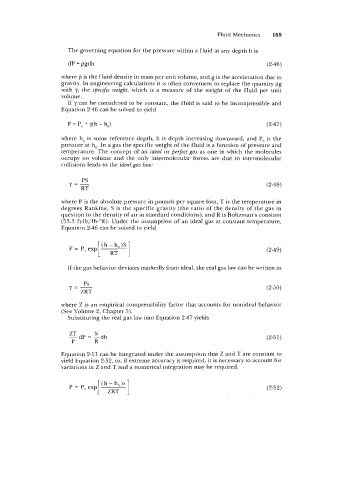
                      The governing equation for the pressure within a fluid at any depth h is
                      dP  = pgdh                                                  (2-46)

                    where p is the fluid density in mass per unit volume, and g is the acceleration due to
                    gravity. In engineering calculations it is often convenient to replace the quantity pg
                    with  y,  the specific  weight,  which  is  a  measure of  the weight  of  the  fluid  per  unit
                    volume.
                      If y can be considered to be constant, the fluid is said to be incompressible and
                    Equation 2-46 can be solved to yield

                      P = P,, + y(h - h,)                                         (2-47)

                    where h,) is  some reference depth, h  is depth  increasing downward, and P,  is  the
                    pressure at h,.  In a gas the specific weight of the fluid is a function of pressure and
                    temperature. The concept of  an ideal  or perfect gas  as one in which  the molecules
                    occupy  no volume and the  only  intermolecular forces are due to  intermolecular
                    collisions leads to the ideal gas law:


                      y=-  PS                                                     (2-48)
                          RT

                    where P is the absolute pressure in pounds per square foot, T is the temperature in
                    degrees Rankine, S is the specific gravity (the ratio of the density of the gas in
                    question to the density of air at standard conditions), and R is Boltzman's constant
                    (53.3 ft-lb/lb-OR).  Under the assumption of an ideal gas at constant temperature,
                    Equation 2-46 can be solved to yield


                                                                                  (2-49)


                      If the gas behavior deviates markedly from ideal, the real gas law can be written as


                      y=-  Ps                                                     (2-50)
                          ZRT
                    where Z  is an empirical compressibility  factor that accounts for nonideal behavior
                    (See Volume 2, Chapter 5).
                      Substituting the real gas law into Equation 2-47 yields

                      ZT      S
                      -dP   = -dh                                                 (2-51)
                       P      R
                    Equation 2-51 can be integrated under the assumption that Z and T are constant to
                    yield Equation 2-52, or, if extreme accuracy is required, it is necessary to account for
                    variations in Z and T and a numerical integration may be required.

                                                                                  (2-52)

