


Page 189 - Standard Handbook Of Petroleum & Natural Gas Engineering
P. 189
174   General Engineering and Science

                                                 Table 2-10
                              Dynamic Viscosity of Liquids at Atmospheric Pressure [l]

                           Temp:
                            "C              0       20      40       60      80      100
                            "F              32      68      104      140     176     212


                    Alcohol, ethyla        37.02   25.06    17.42   12.36   9.028
                    Benzenea               19.05   13.62    10.51   8.187   6.871
                     Carbon tetrachloride'   28.12   20.28   15.41   12.17   9.884
                    Gasoline,b sp. gr. 0.68   7.28   5.98   4.93    4.28
                    Glycerind             252,000   29,500   5,931   1,695   666.2   309.1
                    Kerosene$' sp. gr. 0.81   61.8   38.1   26.8    20.3    16.3
                    Mercq                  35.19   32.46    30.28   28.55   27.11   25.90
                     Oil, machine,.  sp. gr. 0.907
                     "Light"               7,380   1.810    647     299      164     102
                     "Heavy"              66,100   9,470    2,320   812      371     200
                    Water, freshe          36.61   20.92    13.61   9.672   7.331   5.827
                    Water, saltd           39.40   22.61    18.20
                     Computed from data given in:
                     "'Handbook of Chemistry and Physics," 52d ed., Chemical Rubber Company, 1971-1972.
                     b"Smithonian Physical Tables," 9th rev. ed., 1954.
                     c"Steam Tables," ASME, 1967.
                     d"American Institute of Physics Handbook," 3d ed., MeCraw-Hill, 1972.
                     e"Intemational Critical Tables," McCmwHill.

                                                  Table 2-1 1
                                         Viscosity of Gases at 1 Atrn [l]
                         Temp:
                          "C        0     20    60    100    200   400   600   800   1000
                          "F        32    68    140   212    392   752   I112   1472   I832

                          ~~~~~~~~~~~~                             ~~~        ~   ~~
                     Air'          35.67   39.16   41.79   45.95   53.15   70.42   80.72   91.75   100.8
                     Carbon dioxide*   29.03   30.91   35.00   38.99   47.77   62.92   74.96   87.56   97.71
                     Carbon monoxide+   34.60   36.97   41.57   45.96   52.39   66.92   79.68   91.49   104.2
                     Helium*       38.85   40.54   44.23   47.64   55.80   71.27   84.97   97.43
                     Hydrogen*.t   17.43   18.27   20.95   21.57   25.29   32.02   38.17   43.92   49.20
                     Methane*      21.42   22.70   26.50   27.80   33.49   43.21
                     Nitrogen*.t   34.67   36.51   40.14   43.55   51.47   65.02   76.47   86.38   95.40
                     Oxygent       40.08   42.33   46.66   50.74   60.16   76.60   90.87   104.3   116.7
                     Steamt               18.49   21.89   25.29   33.79   50.79   67.79   84.79
                     Computed from data given in:
                     *"Handbook of Chemishy and Pb  ies," 52d ed., Chemical Rubber Company, 1971-1972.
                     +-Tables of Thermal Roperties of%-,"   NBS Ctrmhr564, 1955.
                     I''  Steam Tables," ASME, 1967.
                     where E is the surface roughness. Equation 2-61 can be solved iteratively. If the Reynolds
                     number falls between 2,000 and 4,000, the flow is said to be in the critical zone, and
                     it may be either laminar or turbulent.
                       Equations  2-60 and 2-61 are illustrated graphically  in Figure  2-21. This chart is
                     called a Moody diagram, and it may be used  to find the friction factor, given the
                     Reynolds number and the surface roughness.
                     Example 2-1 3

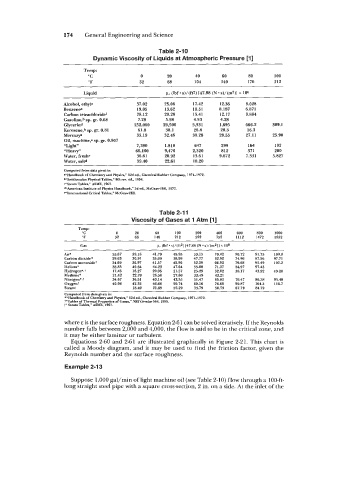
                       Suppose 1,000 gal/min  of light machine oil (see Table 2-10) flow through a 100-ft-
                     long straight steel pipe with a square cross-section, 2 in. on a side. At the inlet of the

